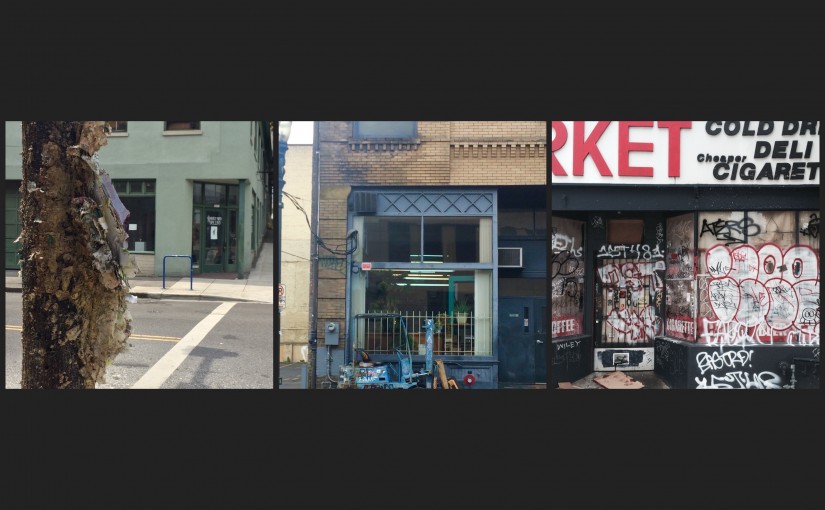
Wen and I have been living here for a month now and we’re absolutely loving it. I thought I’d try and explain why, so here – in no particular order – are some of the reason why this is such an incredible city.
1. The Entire City is a Canvas
I’ve never been to a city with as much street art as Berlin. There are a lot of crummy tags and the like, but there are also untold works of art hidden across the city.
Sometimes the scale is tiny; a painting hidden at the margin of your field of view:
Other times it’s a massive blow-up that can practically be seen from space:
If you take the U1 between Kottbusser Tor and Goerlitzer Bahnhof, this spaceman appears to float on the wall to your north:
In between are countless images waiting to be found:
One of my personal favourites is this samurai warrior who protects the park near our apartment:
The pure essence of this spirit probably best caught in the Kunsthaus Tacheles, a former department store in East Germany that was squatted in by artists in 1990 who have turned it into a series of spray-painted galleries. Walking around it is a celebration of the countercultural energy that built this city (since it was run by the Allies, not the German government, anyone who didn’t want to serve in the German army fled to Berlin where they could keep citizenship but not be forced to do armed service):
But it’s not just illegal art and grafitti. There are plenty of legitimate random works of art around the town too.
Here Wendy and Aine show off just how big Germans are:
I was in the subway and walked up to this kiosk to buy a magazine:
Then I realized that it’s actually a photo of the other side of the kiosk, where the actual shop is:
There is a joy in finding unexpected art around your town.
2. People are Taking Small Steps to Save the Environment
It’s almost a cliche how North Americans are told “if we all just did a couple of small things we could make amazing changes to the environment”. But here in Berlin (and, really, all of Germany), people have actually done it.
People separate their garbage into wet, dry, paper, three different types of glass, metal containers and packaging. There are EUR 0.25 deposits on almost every bottle – and they can be returned everywhere. People bike everywhere – which is easy as there are bike lanes all over the place and posted bike routes. When you go in the hallway outside your apartment it’s unheated and the light is off by default. The street lighting is also running at half power – but the place is so safe that you don’t feel awkward about it.
There are also a couple of bigger things that are being tried. For instance, you can get hydrogen (Wasserstoff) at some of the gas stations:
3. This is a City Aware of, but not Incapacitated, by its History
The 20th century was incredibly destructive for Berlin. The insane, racist, total war of the Nazis meant that it was leveled. This was followed by fifty years of partition at the hands of the Soviets. The full insanity of this is on display at the Topography of Terror where the Wall happened to run through the old headquarters of the SS:
Some cities get stuck on their past and can’t move on (Rome – I’m looking at you). Some try to build for the future but don’t really mean it (Paris, where anything modern has been relegated to La Defense or outside the downtown). It’s rare to find a city that can acknowledge it’s past but build for the present and the future. London does it well and New York isn’t too far behind.
Berlin has done a great job of it – and it’s even more impressive because the history here is frankly so awful. All around town are tasteful reminders of the past:
Any building from the WW II era is a patchwork of replacement stones to cover up wartime damage:
Similarly, the Soviets dotted the city with war memorials to their fallen:
Berliners could have been forgiven for turning their city into a mausoleum for the 20th century, but instead they’ve simply created a new architectural style that builds off the positive aspects of what they had to offer. Incredible modern architecture abounds and is juxtaposed against older buildings:
Interestingly, many of these buildings are schools. The ones below are a cafeteria at a school and a kindergarden respectively:
It’ll be interesting to see if anyone studies whether modern architecture alters the perspective of children.
4. The Light
Berlin is at roughly 50 degrees north. That means that at this time of year the sun struggles to get above the horizon and is so exhausted when it gets there that it doesn’t stick around too long. It throws weak light and long shadows that paint the city is a particularly beautiful hue.
5. The Bread. And the Sausage
Bread justifies people doing strange things. The New Yorker‘s Adam Gopnik moved from Paris to New York because of a pretzel croissant. Having been to the City Bakery (home to said delectable croissant), I can safely say that if Gopnik had been to Berlin and visited any bakery, he’d now be a Berliner.
The pretzel croissant abounds, as do delicious ham and cheese or marizpan or chocolate versions. I am gorging on kaselaugenstange (a finger of pretzel bread with baked cheese on top). Every morning it’s toast from a loaf containing pumpkin and 12 other seeds; sometimes it’s rye from a curiously cylindrical loaf:
There are sweet-smelling bakeries everywhere; sometimes next to one another. Numerous have been strategically placed in subways so that between trains you can get your wheat/rye/oat/gluten fix.
I am salivating as I write this.
But I must continue as we haven’t even begun talking about the sausage yet.
You know a country is serious about its meat in a tube when they’ve created a self-contained, portable sausage cooker:
The bratwurst in this town is incredible, and if it wasn’t for all the bread, I’d probably just eat sausage. In fact, the Bavarian breakfast – two sausages and a pretzel – is a good equilibrium.
The only thing more common than the bakeries are the sausage sellers. While a good bakery is a beautiful bakery, there is an inverse correlation for your friendly sausage vendor. This charmless currywurst (cut sausage with ketchup and curry power) vendor in the middle of nowhere near the Gesundbrunnen subway stop serves such great sausage that I’d go back in an instant:
6. Berliner’s Have a Great Sense of Humour
Those of you who have been to Germany are probably saying ‘Ha, ha – I get it Lindsay; you’re being ironic because everyone knows that German’s have no sense of humour.” But I’m going to suggest that this is not the case and that some Germans (notably Berliners) actually have a great sense of humour.
Here’s a random example of it.
Germany has a popular, but trashy, tabloid called Das Bild. It’s like the New York Post with bare breasts. They make their money with outrageous headlines and frequently the story gets ahead of the truth.
Bild is part of the Axel Springer Verlag and headquartered in their massive skyscraper that used to sit right on the Berlin Wall. Axel was a conservative who hated the communists and he wanted his building to reflect the freedom of the West and be a beacon to those in the East; his papers reflected his conservative ideals.
Two blocks away, in a squat six-storey building, is the Tagezeitung (taz). It’s a left-leaning paper inspired by the likes of Rudi Dutschke (a 60′s liberal who fought against Springer’s views; he ended up narrowly surviving an assassination attempt). They love to try and stir the pot.
First, they successfully petitioned to have their street – Kochstrasse – renamed Rudi Dutschke Strasse – for three blocks: from them just to the Springer building.
Then in 2002 they wrote an article about the alleged penile enhancement surgery of the Bild’s publisher. A suit immediately followed and a court injunction prevented the article from being published. This was followed by an attempt to sue for EUR 30,000 in damages.
But it was rejected by the courts who said that the publisher (Kai Diekmann) “consciously seeks economic advantage from the violation of others’ privacy” and hence “is less severely burdened by the violation of his own privacy. After all, he has knowingly and willingly gone into the business of violating people’s privacy.”
To celebrate this ruling, the taz commissioned a piece of work by artist Peter Lenk and slapped it up on the side of their building (where it’s visible from the Springer building). What is it? Nothing other than a four storey sculpture of, amongst other things, the publisher and his pneumatically enhanced “cobra penis”.
See, Germans do have a sense of humour.
7. Berlin is Home to the Happiest Place on Earth
I could go on, but let me close with one more thing. I have a weakness for chocolate. Particularly Ritter Sport and their nerdy, only-in-Germany slogan of Quadratisch. Praktisch. Gut. (I don’t think a translation is really needed)
So imagine my sheer joy when I stumbled upon the Ritter Sport store. It’s kind of like finding out like there really is a Willy Wonka chocolate factory.
You go inside and they’ll make you your own Ritter Sport bar with pretty much anything you want. They’ve got special flavours that you can’t get anywhere else. There are oversized bars for sale and a cafe.
It’s all Ritter Sport all the time and I love it (and I’m not the only one):
They’ve even got a Ritter Sport advent calendar, so now my Christmas will officially be the best ever:
Berlin. As many reasons to love it as flavours at the Ritter Sport wonderland.
I’m 1,000 meters above the earth and falling at 5 meters per second. Actually, it’s not just me – Wendy’s there too, plus almost 20 unbathed French, German and Japanese tourists.
The funny thing is that I have no idea that we’re falling. We’re not accelerating so I can’t feel anything. Despite the fact that the air is in front of my face – no windows here – I can’t hear any rushing or anything. And the martian landscape we’re above gives no clues as to depth. Add in the fact that the balloons around us are both going up and down and I’d have no idea which direction we were moving if our pilot didn’t tell us.
A balloon ride over Cappadocia is an essential means of seeing the landscape. Every morning almost a thousand people go up in 72 different balloons; it’s the largest collection of balloons found anywhere outside of balloon festivals.
You arrive early to watch them inflate in the pre-dawn twilight.
Depending on the whims of your pilot, you might then rocket to a few hundred meters and watch the other balloons rise. And I should add that you have no idea where you’re going to go; your course is set by the vagaries of that morning’s wind.
Our pilot then dropped down into one of the many ravines that dot the landscape. We all watched speechless as he glided over ledges and dropped down into canyons that contain thousand year old cave dwellings. We could have literally reached out and touched them or plucked walnuts from trees. You can get a sense of it about halfway through this video:
Our pilot then rose quickly to 1000 meters where the temperature is noticeably lower and we got a profound sense of just how thin the bottom of a balloon’s basket is and how far we were from the ground…
Landing is also an interesting time. Since nobody knows where you’re going to land, a fleet of chase vehicles are following you around as you fly. When you land, a trailer pulls up directly underneath you and the basket drops into place. Very professional.
A quick glass of sugary fermented grapes masquerading as champagne and you’re back to your hotel. And it’s not even 8:30 am yet.
2.
In the distance, looming over all of Cappadocia, is the massive volcano that deposited all the rock and ash that makes the area so unique. Except that according to our guide – and one should never fully trust a guide in this touristy an area – there were actually three simultaneous volcanos that flooded the area with ash and lava millions of years ago.
I couldn’t help but wonder if there was a little bit of miscommunication here between geologists and the tourist industry. I mean, think about the word “simultaneous”. For type A people like me, it’s got a pretty clear meaning. At exactly the same moment (define it as the time taken for an atom to change state, a hummingbird’s wings to flag; whatever nano-scale small increment of time you want…), two or more identical things need to be happening.
Now imagine you’re a geologist. You spend your time wondering how a four billion year old rock evolved and most things take millions of years to occur. Unless your one of those adrenaline junkies who studies volcanos and earthquakes, it’s likely that in your entire career you’re going to see nothing happen. All the action has either occurred in the past or is set for the future. That continental drift ain’t fast enough for you to observe. On any given day, it’s the academic equivalent of watching paint dry.
So maybe, just maybe, when the geologists talk about “simultaneous” volcanos they really meant that three volcanos, only separated by a few hundred thousand years, formed the valley. I mean, they could be forgiven for getting carried away in the excitement of a few things happening in less than a few million years and calling it “simultaneous”. In the grand scheme of four billion years of volcanos blowing apart and reforming the earth, that’s a pretty inconsequential error.
But I digress; it’s just one thought that ran through my head as we were in the bus riding from site to site.
And there’s a lot to see in Cappadocia.
Let’s start with those thousands of Star Wars-style (despite any protestations by your guides, none of it was filmed in Turkey) rock-carved dwellings that are ubiquitous. Some have even been converted into hotels:
These were built by early Christians; when anyone invaded, they would rush underground to various cities they had built. The area is literally pocked with multi-layered underground cities. At Derinkuyu you can go eight floors undergound and explore countless booby traps. Interestingly, no one knows how they disposed of their bodily wastes…
There are also vast crumbling castles. The ruins of Cavusin were used from the 9th century until the Ottomans. Erosion gradually pulled down the mountain’s facade and revealed all the dwellings there:
And the similarly ruined castle of Uchisar looks like a failed cross between Mont St. Michel and Kowloon Walled City:
It also happens to have one of the best views of the area…
…and the view from the neighbouring Cafe at Argos is one of the best views you’ll ever find in a cafe (if I could afford it, I’d stay at the associated Argos In; mindblowing place).
The region also abounds with numerous stream-filled canyons, almost all of which can be hiked. It’s fun to descend from the dusty plains into the tree-lined bottoms. At some points you actually have to hike narrowly through ancient hacked-out caves or water-eroded tunnels. Also, beware that nothing is marked clearly; you occasionally come to cliffs and have to backtrack:
Finally, since Cappadocia was once covered in water and composed of different layers of sediment, the rocks have eroded at different rates and left some pretty incredible – and almost unbelievable – shapes behind:
3.
Those early settlers were mostly Christians who excelled at creating churches. There are hundreds of them; when some of them break, the Turkish authorities don’t even bother to fix them or seal them from the elements:
The earliest recorded cave paintings come from the 9th century and are fairly simple:
However, over the next two centuries they got increasingly sophisticated:
When the Muslims came, they began a process of gradual assimilation and slowly exercised their power over the locals. Since Muslims aren’t allowed to worships idols, Christians weren’t allowed to paint eyes on their saints:
What did these people do to survive? Farming was pretty common – and you can see it pretty much unaltered from how it was likely practiced then (the following photo is actually an orchard amongst many dwellings and rocks):
But the real money was in dovecotes. This is a polite way of saying that the locals earned their keep by collecting bird shit. They would create caves that contained numerous alcoves for pigeons and then brick them in:
The red paint apparently attracted the pigeons; once a year they would go in and collect all the guano. Erosion gives the casual tourist a sense of what the alcoves looked like:
Nowadays it is all tourism, all the time. In fact, the main city – Goreme – is literally built out of the old dwellings (as are Uchasir and Cavusin):
4.
If you look at all the photos above, you may noticed the complete and utter absence of horses. This would be of no consequence, except that, curiously, “Cappadocia” means “land of beautiful horses”.
If you go on a group tour of the many sites, remember this, as eventually you will be taken to a jeweler to watch onyx be carved (as a prelude to shopping!). This trinket will then be offered to the first person who can recite the meaning of Cappadocia.
Also make sure to remember that speed is more than accuracy here as your judge is not a native English speaker. If you, as I did, should yell “land of many horses” or something similar you’re likely to win. And then you, like me, will be the proud owner of an improperly finished paperweight.
If one of you kind readers gets it for Christmas, please enjoy your handmade souvenir, created by a Turkish master who has spent his life – just as his father and grandfather – perfecting the art of turning raw rock into emotion. I’m sure you’ll love it.
5.
Cappadocia is a fantastic place and here are a couple more photos to close:
Istanbul. The chaos of 13 million lives. A city bursting at the seams and simultaneously thriving. A place where you cannot escape over 2,000 years of history – nor would you want to. Where the East literally meets the West but it feels more like modern meets ancient. A fantastic place to spend a few days.
1.
A bit about the city. Founded by Greeks but developed by the Romans (most notably, they left the Hagia Sophia) whose Constantine made it the new capital of the empire. Inherited by the Byzantines who built it into the largest city of world. Conquered by the Ottomans; it took 100 years to recover. Now ruled by Turks, it has exploded in population (from 680,000 in 1927 to 1,000,000 around 1950 to 13,000,000 or so today) as waves of first Ottoman refugees and then poor Turks flooded the city seeking safety and economic opportunity.
Each of these rulers have left their fingerprints on the city; most obvious are the great monuments left by each. More subtle are the neighbourhoods. This is not really a city proper, but a series of mini-cities.
There’s modern and hip Begolyu; Muslim women sip wine in restaurants, head scarves are rare and the boutiques all have well labeled prices. There’s a modern art gallery with world class pieces. Movies are filmed. But don’t think it’s all Western decadence – in the alleys off Istiklal you’re as likely to find people playing backgammon, drinking tea and smoking a hookah as you are to find people drinking beer and cavorting.
In ancient Fatih, the crowded, narrow medieval streets are packed with open-faced stores hawking everything (negotiate furiously!), businesses shut for an hour at midday when the mosques overflow and nary a woman isn’t wearing a head scarf.
And then there’s the entire Asian shore, where well planned neighbourhoods abound with people simply living their lives and trying to create a better life for their children; the glass-walled buildings of multinationals border its many highways.
The city proper is incredibly colourful, bursting with it:
Curiously though, the locals seem to only wear dark colours. You can observe this as, on the weekend, you can conceivably walk the many kilometers from the Grand Bazaar down to the Galata Bridge via the Spice Market and then over to Istiklal and eventually Taksim square and spend the entire time in a crowd of thousands:
Perhaps the dark clothes reflect the huzzun (melancholy) that Orhan Pamuk believes hangs over this city (his book, Istanbul, is required reading before visiting the city).
Interestingly, none of the photos above capture the feel of this city. This is a city of interfaces and thresholds. The joy of the city is walking the streets and, in the string of a few hundred meters, finding yourself careening from the lighting to hardware to clothing to outdoor equipment to banking districts. Along the way the streets buzz with deliverymen lugging hundred of pounds of goods and runners delivering tea or food. Men loiter smoking furiously. And when you turn corners you never know what you’re going to see: wild dogs and cats, laundry hanging from a second floor window, an old woman or man teleported from the 1700s disappearing into a closing door or the sudden appearance of a mosque or hammam or cobblestoned alley. You have a constant feeling that things are happening that you cannot understand and all of it is ruled by some sort on unknown code.
2.
The past 90 years have been confusing for Istanbul. The empire collapsed and the city was ignored and began to decay. Then it’s population grew faster than anyone could imagine. The net result is that the city is undergoing massive change. The city used to be almost entirely wooden; you can still see this in some of the older neighbourhoods like Fatih. It can feel like going back in time:
Many of these buildings were torched in the 1950s in a spree that would have brought a tear to the eye of a 1970′s Bronx slumlord. However, you can still find many that have been restored:
The burgeoning population meant that an incredible number of new buildings needed to be built. The older parts of the city went from two storeys to six overnight and the one-horse-wide streets are now clogged with some of the worst traffic in the world; if you hate horns, beware where you walk.
Also, many of these were built on the cheap and are now being torn down. Scenes like this are everywhere:
The city is reinventing itself in six to eight storey standards of glass, steel, plaster and terra cotta.
3.
But no dispatch on Istanbul would be complete without a few comments on its monuments. The sultan used Topkapi Palace to make it clear that Istanbul was an Ottoman city and there were no more Romans or Byzantines to be found.
And the Hagia Sophia stands as a testament to Roman engineering combined with the clash of cultures:
The Grand Bazaar is literally a city within a city, with every store beneath a covered arch. You can wonder aimlessly and quickly lose your sense of direction as there are no ways to see way to see any of the city’s landmarks:
And then there are the ubiquitous mosques. They are everywhere, piercing the sky with their minarets while their stones plays tricks with the setting sun.
The sound of the call to prayer in Istanbul is haunting. Within minutes of each other, dozens (hundred? thousands?) of cries start to ululate over the sky. And within a few minutes it is all gone and it as if it never happened.
You could spend a month visiting the monuments of Istanbul (aqueducts, old city walls, fortresses…) but one additional one that should be on every visitor’s list is the cistern. If it looks vaguely familiar, it may be because Sean Connery rowed across it in From Russia With Love.
4.
For mild hapnophobes (fear of being touched) like myself, Istanbul can present some surprising issues. My first situation occurred when I went to get my hair cut. The actual hair cutting part was fine – no different from what I’m used to everywhere else I’ve had my hair cut. However, I learned that in Istanbul your haircut isn’t done simply because your hair is cut.
The barbershop consisted of two men. A young artiste who cut hair and an older man whose sole purpose seemed to be to make tea (it’s everywhere here and the national drink). However, his real job became obvious once the last strand was cut.
Through a series of grunts and gestures he directed me to lean over into a wash basin where steaming water had been surreptitiously running. He was soon lathering up my hair and running his firm old man hands across my scalp. Then down my face. A gentle poke in the eyes. A rub of the temples and cheeks. This was getting very awkward.
He then dried me off, but we were not done. My entire head – not just my scalp – was massaged. Then he worked his way down my neck and into the shoulders. Most people would enjoy this; I was trying not to squirm in my seat.
Still not done! He found time to slather me in first moisturizer, then aftershave and finally hair gel.
My hair was cut. I smelled nice. And my worst fears have been realized.
The other scenario I faced was going for a hammam: a Turkish bath. I found out that it basically involves you lying prostate, face down on a slab in a co-ed room with a piece of towel wedged between your butt cheeks while a man sits on the back of your knees and pounds your flesh. Not my idea of fun so I settled for a nice steam in the sauna instead.
5.
Turks are insanely patriotic people (or at least, their government is). Everywhere you go it is flags, flags, flags – and pictures of Attaturk.
In fact, you if you sit in a hotel that overlooks the city, you can pass your time trying to count all the massive Turkish flags that dot the skyline; they’re those massive flags that are normally only found in North America on car dealership lots at the edge of the city or next to a highway. They’re second only to the mosque minarets in defining the skyline. And they flap beautifully in the morning air.
6.
The Turks love al fresco dining so cafes and open air restaurants abound. If you wander enough, you’ll eventually find a place where grape vines have been strung across a cobblestone street and tables and chairs brought out.
But if unsurpassed quality is your goal, you will need to hunt a little further. One suggestion (thanks Jascha!) is Develi. The sign above the door says “Kebabs & Baklava” and they do not disappoint. They’re also set in one of the cutest locations possible: a square surrounded by wooden houses and fishmongers.
And no visit would be complete without a visit to Ciya Sofrasi. The New Yorker did a 10,000 word article on them in the 2009 food issue; at the time I thought it bordered on hagiography but having eaten there, I now understand it was not.
The experience is incredible. The restaurant is on the Asian side of the city, so you need to take a ferry to Kadikoy. From there, you need to wander the poorly marked pedestrian streets (one of the few grievances you can lodge against this city), through food and fish markets and past deceptively similarly named restaurants until you find it.
You then serve yourself a vegetable plate. Normally, self service is inversely proportional to the quality of the food, but it’s the opposite here. This mezze plate is one of the best things I’ve ever had, and it was all vegetarian:
To order a main, you walk up to a chef who is keeping a dozen pots of various home-style dishes cooking. You order what you want (Icli Kofte – Turkish stuffed meatball, falafel, and lamb meatballs in a mint and pomegranate sauce for us) and it is brought to your table a few minutes later.
This was easily one of the five best meals I’ve had on our travels and it came with the added benefit of being incredibly cheap for Istanbul. Don’t go to Istanbul – and you need to come here – without a visit.
Wen and I just wrapped up an eight day whirlwind tour of Uzbekistan. It was four cities, over a thousand kilometers of driving, one desert, countless mosques, madrasahs and mausoleums and more mud bricks than you can possibly imagine.
1.
We started our journey is Tashkent. This city was first rebuilt by the Czar who, after winning The Great Game, instituted his peasant eradication program by building a European-style city in the middle of the Central Asian steppes. The city – which has almost no traffic and only white cars – is full of eight lane boulevards flanked by trees, all of which radiate out from a central square.
On this square is the Hotel Uzbekistan in all its authoritarian glory – and it just happened to be where we were spending the night:
Like many things in Uzbekistan, the hotel is not all it seems to be. Despite the exterior, its interior strives to project the bland persona of a business hotel. Think Chinese machine-made furniture in anonymous colours and too much marble and fake crystal lighting.
However, if you’re in search of a drink of water (alas, tap water cannot be drunk here) like us, you might head up to the restaurant on the top floor, where you’re greeted by this sign:
An internet search reveals the following hint of what might go on up there:
This hotel is typical of what you get in this part of the world but is definitely one of the better ones in the area. Interesting item is that the lift goes to the 16th floor and you walk up to the restaraunt on the 17th floor. When you get out of the lift you will be definitely accosted by several prostitutes, The 16th floor has its own brothel. Girls will be knocking on your door at all hours once they have paid the receptionist to find out where all the single male occupiers are. $50 per girl will give you a night you won’t forget in a hurry. These girls are not ugly and some are quite stunning and are very surprised when they are refused. Buy them chocolates and pink champagne and you will be their hero. I stayed here for several months whilst working in Uzbek!!!!
Food is great and there is an eyeopening floorshow with girls in see through negliges. THIS IS NOT A WIND UP I CAN ASSURE YOU as anyone who has visited/worked in this part of the world.
Needless to say, we went elsewhere for dinner.
2.
What the Czar didn’t destroy in Tashkent, an earthquake in the 1960s did, so there’s not a whole heckuva lot to see. However, there’s a beautiful mausoleum/mosque/madrasah complex that includes the oldest copy of the Koran (alas, no photos allowed):
This site (the Khast-Imom complex), like every historical site in Uzbekistan, has been rebuilt. I used to be quite anti-restoration, thinking that if something was ruined, it should simply be left there for us to imagine what it might have been like.
After visiting Uzbekistan, I’m not sure I feel this way anymore. Most of these sites were literally just destroyed arches with a few tiles and collapsed domes. Now they’ve been beautifully reconstructed to almost exactly what they were at the height of their glory. If they hadn’t been remade there certainly wouldn’t be a single tourist who wasn’t an archeology major (instead, every tourist we saw was a 50-plus German or French person; we only saw six people under 40 the entire trip).
3.
As I mentioned above, things in Uzbekistan aren’t always as they seem. For one, the capital appears to be like an Eastern European city: a little shabby due to 50 plus years of Soviet occupation, but coming on strong. However, once you leave the city you realize that things are different. By the time you get to Khiva, mud brick construction is sporadically dotting the highway.
Similarly, the capital has all the trappings of a city, like, say, functioning gas stations. Once you leave the capital you pass abandoned gas station after abandoned gas station. In Bukhara and Khiva drivers were lined up fifty deep waiting for a lonely pump to open based on a rumour that there would be gas there later in the day. Entrepreneurs lined nearby streets trying to flag down cars with black market gas stored in plastic drinking water bottles.
The other major black market is for the currency, the s’um (pronounced like “sum” and “zoom”). There’s been a nasty bit of inflation since independence and since the largest bill is 1,000 (about sixty cents at the official rate), this is what USD 100 looks like; apparently the 10,000 s’um note is coming soon:
However, you quickly learn that the unofficial exchange rate is much, much higher. In Bukhara I was able to get 2,270 to the dollar – or about 40% more. Your introduction to this comes quickly as everyone – your hotelier, your guide, people on the street – will openly tell you that if you want to exchange dollars with them instead of the local bank, they’ll give you a better rate.
My favourite experience was getting one of our guides to help us exchange money. He led me down a set of near-forested back alleys, across a street and into a market that consisted of near-identical stalls selling a uniquely Uzbek perspective on Western fashion. The tenth or so shop turned out to be our hookup and, amongst the jeans and fur-lined jacket-wearing mannequins, they casually started pulling out stacks of elastic-banded 1,000′s to convert my money.
4.
When most people think of Uzbekistan, they think of Samarkand. It’s the most famous of the former Silk Route cities here, and it has the most massive monuments. Beyond Samarkand, I knew nothing of this country before coming here. And, before coming here, if I’d only seen Samarkand, in my naivete, I would have been satisfied.
The first place most people go is the Shaki-Zinda complex. It’s a series of mausoleums with an attached mosque. The finery of the tiling is incredible:
The entrance makes you feel like you are walking through an Islamic cavern:
Another major stop is the Gur Emir mausoleum, where the corpse of Amir Timur is kept. He’s a polarizing figure: he’s got a massive statue built to him in the geographic center of Tashkent; people in the provincial towns that he razed consider him a barbaric murderer.
Next to his tomb is the tomb of a holy man. There’s an interesting tradition here where holy tombs are marked by a yak tail hung from a high post (and I am not making any of this up):
But the real reason people come to Samarkand is to see Registan Square: two beautiful madrasahs that balance a mosque. It’s the postcard for all things Uzbek:
The details of the madrasahs are exquisite. The image below shows the one on the right in the photo above. The orange blobs above the arch are massive tiger lions (locals believe that they were tigers with the mane of a lion; alas they were conveniently hunted to extinction before someone did a proper drawing of one) with a face in the moon above their backs. These are unique in Islamic history as they come from a brief period when imams allowed designs that actually included visual representations of animals and – gasp- almost a human. I think the empire fell shortly after.
5.
If you ever find yourself in the Tashkent airport between 3 and 4 pm on a Tuesday you’ll see an interesting sight. Airports are normally a polyglot demesne, but in Uzbekistan it takes on a whole new level as the two carousel arrival area receives two flights from Seoul and one each from Delhi, Kuala Lumpur, Beijing and Bangkok. Baggage careens randomly onto one of the carousels at an arbitrary time after your flight’s arrival; the locals while away the time with flagrant disregard for the omnipresent no smoking signs.
Flying in Uzbekistan is also an interesting experience. You never have to worry about which airline you’re flying as there’s only one. Uzbekistan Airways is the only carrier that services the country and it does so via a fleet of battered Boeings and aging Iluskyins interspersed with the odd BA Avro and some things that look like they’re converted from fighting forest fires. There must have been a garage sale on some Eastern European airlines in the 1990s.
They’ve also developed their own flying techniques, most notably the ability to drift into the sky and only then fire the throttle. Avid flyers will notice that this is the anithesis of North American flying where you hurtle down the runway as fast as you can and then gradually reduce thrust once you’re in the air.
People also follow the quaint tradition of clapping upon a successful landing. However, I want to give Uzbek Air credit for it’s landings: they are single handedly the smoothest landings I’ve ever felt. You literally touch down and find yourself noting “oh look, we’re on the ground”. The pilots also don’t immediately hit the reverse thrust, so you have a few seconds to reacclimatize yourself with the Earth before you start to slow down. In fact, the pilot of our RJ 85 (yes, it is a model of plane, look it up) actually managed to slow the the plane to halt using only the brakes: no reverse thrust. It was, simply put, the best landing I have ever had. 10/10.
6.
Samarkand was followed by Bukhara – a UNESCO World Heritage site that I’d never heard of until I arrived there. It’s a shame I’d never heard of it, as it’s an ancient town that has over 500 monuments spread over a few kilometers. As you walk around the town you keep stumbling upon more and more history.
It would literally bore you to death if I were to list all the places we saw, but the highlights include the Kalon minaret and its associated mosque complex. You used to be able to climb to the top of it, but a few years back a geriatric German hurt himself (gee, maybe you shouldn’t try to climb medieval minarets in second world countries…) and then had the gall to try and sue the Uzbek government (good luck winning). In a stubbornly autocratic state this unleashed bureaucratic terror and the minaret is now closed for non-existent “renovations”:
To navigate to the complex you pass through several of the “trading domes” where merchants used to sell their wares. Now it’s mostly souvenir trinkets:
On the outskirts of town you can visit the former Khan’s summer palace. It’s built in a combined European/Islamic style and shows the influence that the Czar had over his vassal states:
Here’s the roof of the room where breakfast was served:
This palace also has one of the prettiest details I’ve seen anywhere on this trip. Many of the rooms have alcoves that use the cave design that’s so common in mihrabs (alcove in a mosque that indicates the direction of Mecca); the cave is an allusion to the one where Mohammed first received his messages from God.
In the palace they’ve painted some of the alcoves white and then placed mirrors on the flat bottom of the cave elements. The effect is sublime:
7.
I’ve never been on an organized multi-day tour before, but after this one, I could be convinced to take them in otherwise hard to visit places (to get into Uzbekistan you need a visa and that requires an invitation from a travel agency).
Here are some of the characters we met on our tour:
Anastasia. Our Russian guide in Tashkent. She showed up dressed to the nines in all matching black, heels, makeup and fingernails finished purple. She in her early twenties and has a master’s in English – explaining her fluency. She’s paying back the government (her education was free) by working for them; as she battles for choice roles against the sons and daughters of ministers and prominent citizens, she’s learning how the game is played (Uzbekistan is 174th out of 180 in Transparency International’s 2009 corruption rankings. Unlike golf, a low score is bad…).
Serik. Our Kazakh driver. He speaks a creole of broken English, florid Italian and the odd bit of German. He served in the military and his favourite motion is drawing his finger across his neck. He’s full of humour, referring to an old vodka factory as a “communist mosque”. He also refers to himself as “just the driver” but he is full of interesting wisdom, like the fact that the kindly old man who seems to run our hotel in Samarkand actually is the biggest crime boss in town
XYZ. Our guide in one of the cities. A hint of bitterness came into their voice when informing us that “of course, Uzbekistan has a new king now. But don’t tell anyone I told you that!” This was a reference to Islam Karimov, the undisputed leader of Uzbekistan – and the only leader they’ve ever known.
He took office in 1990 and then, after Independence in 1991, started routinely winning 88% of the vote. Realizing that his popularity was making elections a waste of time and money, he extended his term from five to seven years. Next election is in 2014.
He shows up for all the photo ops and is so beloved for his wisdom that monuments and museums frequently contain tributes to him, like this one from the Ulugbek Observatory museum in Samarkand:
On the basis of National program of personnel training developed and carried out under the direct supervision of our President Islam Karimov the modern educational system fairly recognized by the world community is created in Uzbekistan.
8.
Our last stop was Khiva, another Silk Route trading town that I, sadly, knew nothing about prior to visiting. It’s a stunning walled city, dotted with minarets (that you can actually go up!) and palaces, mosques, madrasahs and mausoleums.
While it’s profile is beautiful, it actually appears quite grey:
However, Khiva is home to some of the most incredible craftspeople you will ever meet and they have tiled the walls, carved the pillars and painted the roofs of all of their monuments:
It’s a beautiful city that we had to rush through in a day; I would have loved to have spent some more time there.
9.
Two things struck me with Uzbek society.
The first is that they are trying to practice autarky (creating an economy that is 100% self-sufficient). Unless they absolutely can’t make it, they don’t import it. This means that you can get a car, but unless you want to pay 100-150% of the price in import duty, you’re going to be getting a locally-made Daewoo or a Chevrolet (and a weird model with a model name like “Lacetti” or “Matiz” or “Nexia”). And it’s going to come in white or silver or black. Why would you want a different colour?
This also means that you can get a chocolate bar, but only one type. Ditto for cola, chips and a whole slew of other consumer products.
It also means that many services, like their airports, pretend at being modern, but since, for instance, there’s only one airline and zero competition, things don’t work as you’d expect. You’ll have time to think about this when two flights leave from the same gate within five minutes of one another (there are not that many flights from Uzbekistan…) and four hundred people need to herd through a six foot wide door to get on unmarked buses to their respective flights. This problem was solved generations ago in competitive economies but autarky means that we’ll have to wait a little longer for the solution to come to Uzbekistan.
The second thing I noticed is how conservative society is.
On our flight to Turkey they played the PG-13 movie “The Duchess”. At the briefest hint of any inappropriate behaviour (usually an amourous scene), the movie would cut away to images of Air Uzbek planes flying over mountains.
The plane also had an informational pamphlet on AIDS that included the following gems:
Q: What is the relationship between HIV/AIDS and people traveling abroad?
A: By going to another country for employment opportunities, business trip or tourism purposes; as well as being away from family in a new environment, changing lifestyles, the person is more exposed to the risk of being infected by HIV/AIDS.
and:
Virus transmission may occur in the following cases:
1. Unprotected sexual intercourse with persons of easy behavior.
…
This is likely a holdover from the particularly conservative branch of Islam that was/is practiced here and led to sharia being law until 1920. In Khiva, when the law was revoked, there was a festival held where women could burn their body-covering paranjas. Many women burned them and upon returning home with hair uncovered, were stoned to death by their family members.
In fact, the paranja is possibly the most suffocating device ever created to spare a woman the lustful glances of men. It’s a smock that drops down over a woman’s feet and contains decorative sleeves: her actual arms are contained within the garment. The kicker is a veil that’s a mesh of horse hair so that it’s impossible to see any part of the woman’s face:
Here’s a too-short one modeled by Wendy:
10.
The food in Uzbekistan is great. They specialize in lamb shish kebabs; if you get whole meat chunks, they come deliciously coated in salt to keep the flavour in during grilling:
Here’s the ground meat alternative:
The locals are also proud of their bread (and they bake it in a tandoor!). Each city has a variant on the same style of loaf; the people of Samarkand claim that there’s is so good that it will stay fresh for 100 years:
Quite a few dishes involved a stuffed surprise. This one was lamb crepes:
Here is a pepper stuffed with lamb and rice:
Again, the food is delicious (if you like lamb). It does take a little while to get used to the cooking style: since Uzbekistan is the world’s 3rd largest cotton exporter, everything is cooked in cottonseed oil.
11.
A few other random things I noted while traveling there:
Many Pakistanis come to Uzbekistan as it’s close and cheap. Mostly large groups of men. One of our guides told us that they quickly visit the sites and then go out and get truly wasted as it’s apparently rather difficult to do so back home
They used to have slavery in Khiva and on a truly colossal scale. When it was outlawed in 1873, they found themselves with 40K new citizens versus a population that used to only contain 30K official citizens
Names are impossible to pronounce here. One particularly overzealous soap opera actor has three apostrophes (!) in his last name
The local instruments make beautiful music. Here’s a guy demonstrating a few of them; skip ahead to 1:40 hear him play the Tor (12 strings). The Chang (75 strings) is right after: uzbek_music
We’ve spend the last few days skulking eastwards from Rajasthan towards Delhi. This has given us a chance to see all sorts of little towns that most people won’t see as they don’t have enough time. This is one of the little joys of India: the density of history is so high that there are literally hundreds of towns with something worth seeing. Compared to the great sights of India each is unremarkable, but most countries would kill to have just a couple of towns like them.
We spent a few days in Bharatpur. It initially appeared as a charmless, dusty city but in the middle of it is a massive fort. The moat now swells with plastic bottles instead of water. Once you make it past the ramparts though, things start to change.
It’s a “working” castle: many people live inside the grounds plus there are the remains of various different palaces. Impressively, there’s a park within the walls; this might not sound like much, but it’s quite the luxury for India. Getting a fresh pomegranate juice and sitting in the park was a welcome moment.
The highlight is one of the palaces that has an ancient hammam (Turkish bath) attached:
The main reason people come to Bharatpur is to go to Keloadeo National Park. About 150 years ago the Maharajah decided that he wanted a private duck hunting area. He irrigated a 29 square kilometer plot of land and then would invite people over to slaughter animals with extreme prejudice. The British took him up in earnest; on one particularly bloody day, 39 men managed to kill over 4,000 birds (there’s a plaque to memorialize these brutal hunts).
Fortunately, it’s been a national park for over forty years now so there’s no more hunting. You can while away a pleasant day by renting bikes and exploring the park on your own. We say a wealth of wildlife: black ibises, painted storks (below), kingfishers, peacocks, cormorants, parrots, hare, giant squirrel and the ubiquitous cow (there’s not supposed to graze in the park, but hey, you know…).
Conveniently, the folks at Keoladeo had jacked their prices – presumably for the Commonwealth Games. The price increase was so sudden that they didn’t even have a chance to update their flyers, which still had the 50% lower price:
About 40 kilometers away from Bharatpur is Deeg, which is famous for its water palace. This massive complex has over 200 fountains (alas, not turned on) and many of the building still contain the original furniture (alas, photography is not allowed).
The entire place is a celebration of India’s scarcest resource. Check out the maze created below for catching rainwater:
2.
India is a case study in social norms – because when you get here, you realize that so many of the things you take for granted are completely different here. To wit:
Spitting. Every morning the men compete with one another to see who has the greatest lung capacity and can summon forth the largest loogie. This is particularly charming when you’re lying in your hotel bed and all you can hear is the sound of nearby hawking.
Littering. Almost everyone throws their garbage in the street. If you pay attention you’ll notice the various different ways people dispose of their garbage: carefully pouring it on the curb for a cow to eat, tossing it off the roof or maybe just freely flinging it out the window. If, like me, you’re unlucky, someone will throw their garbage out a bus window at the exact moment you’re passing by in an open-aired tuk tuk.
Dress. Shorts are vulgar and a sign of disrespect, particularly if worn in a religious building. However, it is nothing to wear a sari that exposes one’s sagging stomach.
Pedestrian rights. In a nutshell, they don’t exist. People will drive right up into you and if you don’t get out of the way you will be hit. If you’re going to cross the road, you’re taking your life into your own hands: don’t expect anyone to try and dodge you. Caveat pedestor.
Personal space. Like pedestrian rights, this is non-existent. In an overpopulated country this shouldn’t be unexpected, but it takes a while to get used to people coming right up to you. More awkward is when you’re riding on the bus and the unperfumed man in the seat next to you puts his arm behind you and rotates toward you, allowing his ample stomach to sag over your leg. Did I mention that I hate being touched by people I don’t know?
Personal space II. Indians love music and associate it with a good time. Consequently, people play music here all the time (see Agra below). For most people this means on their cellphone. However, nobody uses headphones: they just blare their music without consideration of what anyone else. Manufacturers have caught on: the #1 feature in an ad for a popular phone is its dual stereo speakers.
Queueing: forget it, it’s a battle. Everyone for themselves. Sharp elbows are mandatory or you’ll still be standing in line an hour later.
Now, these are social norms and that means that they’re learned behaviour and changeable. The Indian government seems to think that a few of them might be worth trying to change: there are ads on tv to teach people that cutting in the line is bad behaviour and that some civility in driving can be nice. Moreover, in the few areas of the country that have garbage cans (e.g., Amber Fort, parts of Agra) you will see nary a piece of litter.
It will be interesting to see which ones society chooses to keep vs. change.
3.
After Bharatpur we went to Fatahpur Sikri. This tout-filled town used to be the capital of the great ruler Akbar, but it lacks a steady supply of water and was abandoned after Akbar’s death. It’s now a UNESCO world heritage site with an impressive mosque and equally incredible palace.
The only thing more ‘impressive’ than the buildings is the tenacity of the touts. We arrived via a motorized rickshaw; touts actually jumped into the front seat where our driver was sitting (people are always hopping on/off the front of your rickshaw, hence this was nothing new) and persuaded him to drop us off far from our hotel. I fell for this, forgetting the basic rule of travel: never get out of the vehicle before your destination, and thus had to deal with the touts.
This was not my finest moment. I was soon swarmed by at least 8 guys all trying to sell me postcards, multiple rickshaw rides, trinkets, bangles, guides, hotel rooms, etc. And nobody would take no for an answer. After trying to walk away and telling everybody “no” at least three times, I lost it. I quickly became that guy I never wanted to be and found myself screaming expletives at the touts to get them to go away. LIke I’ve said many times in this blog, traveling in India can be hard.
After we checked into our hotel we went to Akbar’s great mosque, graced by the mighty 54 meter tall Buland Darwaza (Victory Gate).
The touts have taken over this mosque complex – I think mainly because it does not charge an entrance fee. You have to leave your shoes outside where, if you’re a foreigner, you’ll have to pay a kid for the privilege of not having them stolen. Once inside, a tout – who insists that he is not a guide and will not, under any circumstances, accept payment – guides you around the complex; you have no choice but to accept. As you marvel at the architectural details and finery of the mosque and adjoining buildings, you’ll also get to fend off his attempts to sell you blankets, soapstone carvings and the eventual negotiation of a ‘gift’ for his services (and all the while he will tell you that you’re being rude/cheap by not buying anything/giving him more money).
Fortunately, next door is Akbar’s tout-free palace complex. Akbar is one of history’s most fascinating rules: while a muslim, he had three wives – one Christian, one Hindu and one Muslim. He understood that it was much more efficient to subdue the Hindu population by negotiation than force and his reign was marked by prosperity and growth. This is evident from the remarkable complex he left:
One of the most interesting buildings is the Diwan-i-Khas (Hall of Private Audiences) where Akbar would speak with is advisors. He stood on an upraised plinth, each connected by a gangway to a corner where a minister would stand. He would ask a question and rotate through his advisors for answers:
4.
There’s not a heck of a lot to do in rural India at night, so when we’ve tired of reading, we’ve watched tv. Indian television is a 200 channel universe of soap operas, Bollywood movies, singing, dancing, Business Television (talking heads and scrolling headlines who take themselves very seriously), holy men and the odd foreign channel.
You start to realize that there are certain archetypes in the tv culture:
The man-child: an early twenties to mid-thirties male who wears jeans and frequently a wife beater (known here in its less pejorative term, the “sleeveless vest”). He is truculent and insolent and incredibly cool yet still able to respect his elders.
The urban modern: an early- to late-twenties woman who wears western clothes, works, and lives in an apartment in a major city. She represents all of India’s hopes for the future yet secretly also their fear that modernizing may require them to sell out their culture
The self-confident traditionalist: also an early- to late-twenties woman who only wears saris and traditional clothes. She is much more reserved and subdued than her urban modern counterpart, but do not try and run truck over her. She embodies an India unsure of what it wants, trying to balance all of the nation’s history and traditions amongst the technology and pace of the modern world
The dominator: mid-forties to mid-sixties men and women who play overbearing father – and more usually – mother-in-laws. Again, this is the best and worst of India. They hold the family together and ensure that traditions and heritage are passed from generation to generation. Simultaneously, they do not easily let their children grow free and learn to live for themselves.
You may notice that there are a couple of groups that aren’t too well represented here:
Kids: you only see them in commercials
Seniors: as far as tv is concerned, they might as well not exist
Women with kids: ditto. You should be at home raising your kids, not being on tv. Only men of this age should be on tv.
Equally interesting are the breadth of commercials (I subscribe that the best way to get a feel for what a society feels about itself is to watch its television commercials). Almost all are deludedly aspirational: people sip coffee or eat snacks in beautiful, modern apartments that look like they’re out of New York or London. Some are ridiculously macho: a beautiful woman in an evening gown signals with a handkerchief, causing a jeep to burst over a sand dune; a man gets out with a golf club and knocks a ball into a cup. And many play to your emotions by using children as pawns; perhaps that why you otherwise don’t see many on tv.
A couple of the more interesting commercials we saw were related to matrimony. Most marriages here are arranged (a Western style marriage is called a “love marriage”) and it’s near impossible for guys to meet girls. One ad we saw was for a matrimony service; think online dating where the goal from the outset is finding a wife.
Another ad started with a stunning woman staring at the camera stating unhappily and stating: “ours was an arranged marriage”. Cut to various scenes of her and her husband feigning interest for one another while obviously masking an inner indifference. However, then one day on the train they try to find each other and realize that they actually love one another! And then they go out and buy matching rings to celebrate the day they fell in love after they were already married.
Probably the strangest thing on Indian television are the channels devoted to various gurus and religious leaders. These channels are pretty basic: a guy sits on a stage and yells/dictates/sings while an audience watches or calls in. This is a very conservative society so there’s no boobs or bad words on tv, but occasionally something odd slips in via these channels. We were flipping channels and witnessed a ceremony where an overweight, naked, middle-aged guru walked up to a row of seated disciples and touched each of them on the head. These brave pilgrims sat unblinking.
Like I said, tv is a fascinating window into a country.
5.
What is that noise? Is someone throwing squirrels in a meat grinder? Has a hyena been run over by a steam roller? Oh no, it’s just 5:30 in the morning in Agra and the local sound system (they’re everywhere in some towns) has decided to crank some Hindi music at 150% of tempo.
Well, sleep is blown, so let’s get up and go see the Taj Mahal.
But before the Taj, let me tell you about a couple of other stunning attractions that Agra has.
If it were in another city, the Itmad-Ud-Daulah, aka The Baby Taj, would stand on its own as a powerful tourist attraction. Due to the Taj, it gets barely any traffic. Which is a shame, as most people will miss out on the incredible detail that has gone into its construction (like the Taj, it too is a mausoleum to a lost wife):
Agra Fort is another of India’s innumerable UNESCO world heritage site (no other nation has done as good a job of getting their monuments listed as India; it seems like there’s one in every city – and each is legitimately on the list). This massive fort is steeped in the complex political history of India. Aurangzeb’s father built the Taj Mahal; he overthrew his father and locked him up for the rest of his life (8 years) in a room that overlooked the Taj; Aurangazeb’s throne overlooked both his father and the Taj.
Despite their individual grandeur, each of these sites is overshadowed by the Taj Mahal. Simply put, the Taj is just that much more amazing that just about any other building you’re seen. Viewed in the morning sun at a distance of 200 meters or so, it radiates like the perfect embodiment of one man’s love for his lost wife. As you get closer the immensity is replaced by the ornate detail and the subtlety of the carvings combined with marble so polished that it reflects.
It would be criminal to visit Delhi and not go to the Taj.
6.
Speaking of which, as we drove into Delhi everything began to make a little bit of sense.
As we’ve been traveling through this country, one the biggest mystery to me has been “what does everyone here do for work?” This has been made even more puzzling for two reasons:
As we’ve driven through dozens of towns – some with populations in the millions – we’ve hardly seen any factories. Contrast this to the Factory To The World that is Southeast Asia/China where the social contract is obvious: move to a town, work in factory, remit money home and live a better life than your parents
We see ads everywhere – and I mean literally everywhere: in magazines, on billboards, painted on walls – for IT, engineering and management education. My favourite ad showed two young women in leggings sitting at their laptops happily working away; nothing could have been a better embodiment of what this country oh so yearns to be. However, all of these factory-less towns have also been IT-less towns; no squat, shiny, campus-style mirrored buildings that smell of technology companies
This has compounded the disbelief I’ve had watching television here; especially when watching commercials, I haven’t been able to figure out where in India it’s supposed to be. The apartments? People in parks? Most of the scenes look as foreign from where I’ve been as Mars. Now I know that Indians have a great suspension of disbelief – witness your average Bollywood movie; sheer escapism – but this was bordering on the delusional.
But back to Delhi, as it all started to come together.
As you drive into town, you immediately notice how different it is. On the outskirts, brand new technical universities (Fully air-conditioned! 100% placement assistance!) are emerging out of the dusty plains. The tentacles of a metro (infrastructure!) reach into the hinterlands and tower over many city neighbourhoods.
The metro has brought with it easy transportation and alongside it sprout multi-storey shopping malls, giant apartment complexes and corporate offices. Those fancy, glass-enclosed, three storey testaments to technology that India so covets as its hope to becoming a superpower.
Bingo. Now this country is starting to make sense! Now I have an inkling of how it works and what it might mean.
So, what do I think? Well, I think that in India we’re witnessing the eradication of poverty and the rise of a middle class on a pretty massive scale. I also don’t think it’s happening anywhere near fast enough – and particularly not fast enough for India to become a major superpower any time in the next twenty years.
The crux of this is due to India’s focus on services and allowing China to have all the manufacturing fun. Services, on a per person level, probably bring in more income per job than manufacturing. But it comes at a cost: you need a highly trained workforce. That education is not going to come from the government alone (a high school diploma ain’t enough), so India has been building out a massive higher educational infrastructure.
However, it takes a heck of a lot longer to build a university and get it up to speed than it does to build a factory to assemble irons or lampshades. So you can’t grow as fast as your neighbour to the north. It also means that you’ve got a small part of your workforce (the service sector) fully employed and the vast majority of your workforce (the other 90+% of your workforce) vastly underemployed.
There’s a more subtle – and potentially more socially jarring – long-term consequence to this as well. People who work in services are going to want to work almost exclusively in big cities. Intellectually stimulating work tends to require intellectually stimulating play in your spare time and alas that’s typically not found in villages (for more, read Richard Florida or John Hagel). Moreover, these people are going to move to cities where there are already people like them; they’re less likely to slug it out in a ‘boring’ city (unless the pay is really, really good; not a likely prospect right now).
I think this explains why so many of India’s highly educated elites go abroad for work and show little interest in returning. It’s not that they’re not Indian patriots, rather they’re too stimulated by what they get overseas and can’t imagine going back until something similar arises in India. And once they have kids, they almost certainly won’t go back as their kids won’t give up what they’ve got.
But something similar is arising. I believe that India is going to see the rapid rise of a few incredible cities that will be more like states. They’ll go toe-to-toe in attracting the best and brightest across the world. Think Delhi, Mumbai, Chennai and Bangalore. Maybe not for a few more years, but barring catastrophic mismanagement (which is a possibility due to the endemic corruption here), they’ll get there.
The flip side of this is that this means huge wealth disparity in the country. India’s elites will be more comfortable and able to better to relate to people in London, New York and Tokyo than people in a rural village in Uttar Pradesh or Bihar. In ten years I wouldn’t be surprised to see something like 250,000 dollar millionaires (currently about 115,000) and 400 million people living on less than $2 a day. The wealth inequality is going to make America look like a socialist country.
Is this bad for India? I honestly don’t know. It might not happen; if it happens and is left unchecked it could lead to ridiculous scenarios like secession demands by the new princely city states who want to be the new Dubai (I’m being purposely melodramatic).
It’s also definitely not irreversible. India currently has zero focus on reducing poverty in the country at either the personal or governmental level (literally: the rich don’t give to charity and there’s no national strategy or execution on improving welfare). If this changes to spread the wealth around – and this doesn’t mean higher taxes; it likely means better thought growth policies – the situation could definitely change.
It’s going to be really interesting to see how this country plays the hands it’s been dealt. Mixing metaphors, the ball’s in your court India!
This part of Rajasthan is a land of superlatives and machismo; it is the Texas of India.
Jaisal built a golden city in the desert by erecting a massive fort on top of a rock. It thrived along the Silk Road. Unsurprisingly, he called it Jaisalmer.
Jodh responded by building an even bigger fort on top of the rock near his town. And it was known as Jodhpur. He also let the Brahmins paint their houses indigo, hence the town is now known as the Blue City.
A few hundred kilometers away, Jai decided that he would not be outdone. He build a palace beneath a fort nestled amongst hills crisscrossed with fortified walls and then built another palace in a lake. Unsatisfied, he decided to build a whole new city – arrayed along grid lines – with a palace at its center and then painted the whole thing pink. In keeping with the theme, Jaipur is known as the pink city.
When not erecting monuments to themselves, the kings of these different city states would attack one another over petty grievances. For instance, raiding each others’ caravans, snubbing one another’s invitations to meal and therefore laying siege to cities, etc. The usual contrivances of small principalities.
With Independence they were all forced into one state which was called Rajasthan as it is the land (stan) of kings (raj). Nowadays there are still Maharajahs, but they no longer command armies and audiences. To attack one another they use the major tool at their disposal: the audio guides to their respective forts.
When you tour the different fort/palace complexes it’s advisable to get the audio guides as there tends to be minimal signage. Each tour explodes with hyperbole about how the carvings/gates/walls/howdahs/palanquins/weapons/warriors/etc. of that palace are the most ornate/strongest/most beautiful/biggest/fiercest/etc. in the world.
There are interviews with the Maharajahs plus the CEOs and Senior Lead Researchers of various charities and foundations (people here are obsessed with rank and titles) tossing you pearls of wisdom about the pomp and prestige of the each fort.
A slightly revisionist history has been written where there are only brave warriors and the forts are unconquered (ignoring that several times the forts fell when guards were bribed). The Rajput kings are now unbeaten – but what’s left unsaid is that the Mughals coerced them into siding with them, understanding that they never needed to beat them to control them (the British then did exactly the same thing again).
Moreover, we hear about how strong and wise some of the Maharajahs were. For instance, there’s one of Jaipur’s Maharajahs who was made a brigadier general (or something similar) by the Brits in World War II. What’s not mentioned is that he was 22 years old and surely this could not have been for political purposes (I’m sure it was due to his Rajput attitude of “death before defeat” as is frequently repeated in the audio guides).
In all sincerity, the guides are great and they walk you through breathtakingly complex structures with hundreds of years of history. They could just use a little humility (for more on this theme, see the section below on the Commonwealth Games).
2.
Wendy is extremely popular in this part of India. Witness the following:
Everywhere we go, people want to have their photo taken with her. It’s cute.
Less cute is when boys want to have their photo taken with her and then paw her/try to kiss her/etc. That’s when my blood boils and we call a halt to it.
Equally less cute are the stares that she (and me, but more her than me) gets as we walk around. Hardcore leering: men stop work and stare at her. Boys on motorcycles gaze unblinkingly. When we sit in restaurants she has to turn her back to the crowd.
Sometimes if I stare back at these yokels they’ll stop but frequently they just don’t seem to care. The irony is that if I stared at their wives or daughters like that they’d probably come after me with a knife.
But it would be impossible for me to stare at their wives or sisters because they’re all practicing pardapratha – or parda (pronounced per-dah) for short. This is a tradition – imported to appease the Mughal overlords – that states that all women (and we’re talking predominantly Hindus here) should cover their face with a veil to protect them from the leering glances of men. There’s an even more conservative interpretation that insists that women should not go outside.
As a result, you see a disproportionate number of men on the street and rarely intermingled groups of women and men. In villages you never see women at all (unless they’re collecting children, searching for firewood or drawing water while men sit around smoking, chewing paan or drinking chai).
The whole damn culture is built around segregating women from (and keeping them below) men. When you visit the beautiful Meherangarh fort at Jodhpur, you learn that the beautiful carved courtyards were created entirely so that women could look out from behind a screen (jali) and not be seen by the men below.
Ditto with a whole wing of the Amber (near Jaipur) palace where only women were allowed. The Maharajah wasn’t even allowed in and eunuchs sent messages from him to his harem and back. In fact, the only royal woman allowed out was the mother of the current Maharajah; the rest had to stay inside (I can only imagine the politics this created within his harem; the quest to have your son become designated heir must have taken on a whole new meaning…).
(More royal nonsense: in Jaisalmer and Jodhpur, when the Maharajah died, his wives were expected to walk into his funeral pyre. This tradition was finally snuffed out in 1834 or so).
Parda, a purely cultural and not at all religious tradition, has survived the decline of the Mughal empire and shows only a few signs of abating. In the cities you see younger people of both sexes intermingling, but it’s the exception, not the rule.
In fact, this conservatism has trickled into many other aspects of life here. For instance, I have not seen a single woman driving a car. I could be in Saudi Arabia.
I’ve only seen two women wearing an outfit that revealed their shoulders. Both were young women who were obviously from a city (big sunglasses and skinny jeans). I haven’t seen one woman wearing an outfit that shows her calfs. A further irony is that the men are encouraged to show more skin: Bollywood actors have made the sleeveless vest a popular look for muscular men.
An interesting aspect of this conservatism is that it’s only come about in the past few hundred years (I’ll guess its perfectly correlated with that Muslim invasion). When you visit any number of the ancient Hindu temples around the country you can’t help but be struck by the early Indian love of the full bodied, scantily clad, big breasted woman. There are statues to them everywhere.
In other temples you also witness couples carved in erotic poses from the kama sutra. And there are numerous paintings of bare breasts and shoulder in paintings depicting scenes from the Ramayana and other sacred Hindu texts; only in the more recent versions do wobbly bits get covered up.
3.
Being close to the Pakistani border, this is one of the most heavily militarized zones in the country. As you criss-cross the state you pass numerous garrisons, each proudly displaying their division’s name: Desert Foxes, Lightning Lancers, Prancing Prancers (okay, I make that last one up).
And, in case you weren’t sure about it, the enemy is Pakistan. Outside Jodhpur we drove by one military base and perched before it was the half-destroyed fuselage of a 70′s era fighter plane; the Pakistani flag is still visible on the rear wing.
In Jaisalmer, you’re constantly reminded of the nearby presence of Pakistan. The airport is run by the military and while there’s technically a commercial flight out of there, it hasn’t run in ages (although you can confound yourself trying to book it on Kingfisher Airways’ website). And given the number of military jets performing maneuvers there, the risk of a commercial jet getting too close to the border is probably just too high (especially as these nuclear enemies are only about 30 seconds away from each other by missile; Russia and the U.S. were nine minutes).
Interestingly, the flights appear to be under radio silence. We would sit on the roof of our hotel under the blazing sun, with the smell of raw sewage occasionally wafting over us (this just randomly happens in India), and watch the jets scream in to land. Once we saw a flare rocket up from the ground and the incoming plane broke right; three minutes later he came back and made the landing. I’m guessing the runway wasn’t ready and the only way to signal it, sans radio, was to fire the flare.
4.
Jaisalmer is also probably the only city I know of where you can still get a stone house build. And it’s not just any stone house either: it’s going to be sandstone carved into some of the most ornate screens and details you can imagine. These are some of the best stone masons in the world:
Like all things, there’s no such thing as a free lunch. The downside here is that there are open sewers and the streets are lined with cows and boar (the dark spot beside the cow) to dispose of garbage:
5.
Wendy and I went on a one day camel safari. It would be better described as a two hour camel ride followed by a night on a charpoy (webbed bed)in the desert, but that doesn’t sound quite as romantic.
In was a great time. The sun in the Thar Desert is stupefyingly hot plus the desert is more scrub than sand dunes (they appear intermittently), so anything beyond two hours would frankly get a little repetitive. You’d feel like you were seeing the same thing over and over again. You’d want a break from the monotony of the repeating scenery. You…
More importantly, Wendy got to ride a camel; her second favourite animal after elephants. Our camels were incongruously named “Lucky” and “Babluji”; I can’t remember who had which:
The scene above shows two of the overwhelming contradictions that you find in India.
The first is that Ali, my camel driver, is able to talk on his cellphone in the middle of the desert. It’s amazing how wired this country is (and they don’t even have 3G networks yet; can’t wait to see what happens when that occurs); everyone is connected.
The second is that Ali’s nephew Salim is leading Wendy’s camel when he should really be in school.
When I think of child labour I think of Dickensian factories with little hands for little places and it all takes place behind closed doors. I know that some of that exists here, but a lot of the 12-60 million child labourers (gov’t vs. 3rd party numbers) here are doing much more mundane things. Washing cups at a juice stand. Updating inventory at a store. Carrying water or maybe just leading camels.
At first you think they’re just helping out part time but when you go back the next day and they’re still there you realize that this is their life. It’s scary how banal child labour is here.
In this charming scene straight out of the 20th century – BC, not AD that is – this son is helping his father out blacksmithing:
Okay, I pulled a cheap shot with the photo above (although I stick with my statement that the blacksmithing techniques are the same as those used 4,000 years ago). This kid is actually in his school uniform. He’s actually a symbol of one of the truly great features of India: society’s incredible drive to educate their youth. He’ll almost certainly never work as a blacksmith and hopefully won’t work outside at all.
It’s heartwarming to see the quest for education in this country. As you walk the street of any town or read any magazine you are bombarded with ads to learn how to program, to get an MBA, to become an engineer. (In fact, the most common ads seem to be for cell phone carriers, cement and advanced degree programs)
If you’ve ever taken a subway in New York or any other North American city you’ve also been bombarded with education ads. However, they’re for online associate degrees to become nurse assistants or medical billers; they’re low value training offered by scam universities.
I can’t speak to the quality of the education being offered here (but India has some of the finest universities in the world; witness the IIT’s), but the sheer scale of it and the focus on the higher end of the value chain is awe inspiring. I can only imagine what it’s going to be like here in 20 years when the country is teeming with highly trained people trying to solve all the complex problems India – and the world – faces.
These guys have a great future:
6.
One of the things you have to come to terms with when you travel in India is that, unless you’re buying railway or airplane tickets, there is not a single listed price in this country. And even if someone does show you that elusive listed price, it, like everything else, is negotiable.
Moreover, you are a walking ATM. Your mere presence as a tourist makes you a mark: everyone is going to try and rip you off. In fact, it’s almost perfect game theory: you’re unlikely to ever do another transaction with anyone you meet here so they’re going to try and extract the single highest price they can get from you at that very instant.
This means you should expect any of the following to happen:
You go to a fort. There are rickshaws outside and you ask the price back to your hotel. It is IDR 250. You offer IDR 100. You are then told how these are reserved rickshaws and therefore cost so much more. Threaten to walk away and you get it for IDR 100.
You call a hotel. They quote you a price that is way north of what is in your guide book. You quote the guide book. They offer you a 10% discount; now only 40% more! You reply with “I’ll pay <book price>” and they say no. You say “okay, I’ll go elsewhere” and they cave.
You want a driver. You go to the government tourist office and they show you how it costs x/km and you’re going to have to pay 2x that as the driver needs to come back. You quote the price you’re willing to pay (~1/2-1/3 less). The tourist officer tells you how he knows a few people who don’t work for the government and maybe they could get you a price below the government rate; you end up paying almost what you wanted
You’ll notice a common theme here as to what to do: threaten to walk away. In a country of over a billion people there are thousands of other people within arms reach who will happily sell you the same service for a lower price.
Another common experience you’ll have: people will follow you around trying to extort money from you. A common modus operandi is that you walk into a fort/palace/etc. and someone starts following you around. You say “thanks, but I don’t need a guide” and they say “oh sir, I’m not a guide; I just want to make sure you see a few things.”
At this point, you have two options:
Tell them you’d like to just walk around by yourself
Get ready to listen to sob stories: “I don’t make much money”; “My father is old and I am responsible for my family”; “I need to get a gift for my girlfriend.” It never stops
A similar approach is followed by some touts. They come up to you and start to engage you in pleasant conversation that it would be rude for you to shut down e.g., “where are you from”. This is followed up by a compliment to you: “you look like a Bollywood star”, “you take nice photos”. All of this is buttering you up for the ask: “why don’t you come by my shop”.
They’re using the law of reciprocity (doing something positive to you in order to make you feel like you’re indebted to them) in order to guilt you into their shop, etc. You’ve just got to be firm in letting them know that they can talk to you but that under absolutely no circumstances will you go in their shop/give them money/etc. It’s also fine to request you be left alone for your own privacy.
There are a lot of other tricks people use to try and get your money. At forts, the ticket issuers take extra long giving you your change, hoping that you’ll forget it and walk away; they even post signs telling you that if you don’t check your change before leaving the wicket, you’re out of luck. Not only will your admission price be 4-20X an Indian, you’ll also need to pay an additional camera fee.
If you have a driver, when you reach your destination, your driver will ask for more money saying that he miscalculated the rate (and this is after he picked a restaurant where you’d be overcharged so that he would eat for free). Drivers, in fact, are particularly stubborn: we’ve had a few who have tried to negotiate toll rates on the highways.
You’ve got to be in the mood to handle these things or you’re going to go insane.
Also, remember that none of it is personal.
We’ve had fierce negotiations over rickshaw prices (usually over $1; hey, it’s principle) where the driver is trying to make me feel like I am pulling food out of the mouths of his starving kids. Minutes later we’re in his rickshaw (usually at our price) and he’s asking us where we’re from, telling us how his family is so happy, etc.
It’s like we’ve never met before…
7.
From the above, you might gather that I don’t enjoy being in India. Not at all.
Rather, India is a place where you have to learn to balance two exactly opposite ideas in your head. You’re going to love what you see and experience. Unless you are paying a small fortune or traveling with a local, the process of getting to experience it is going to be awful. Zen, zen, zen…
Here are some snapshots of various great things we’ve seen recently. All were worth it:
8.
Jaipur has some pretty stupid traffic, but it’s manageable:
As you struggle to cross the road (note the local above throwing her arms up in exasperation), you can play traffic bingo by trying to count all the different forms of transports: motorcycles, bicycles, tricycles, auto rickshaws, bicycle rickshaws, cars, trucks, buses, tractors and camels:
Less fun is the traffic we faced getting to Jaipur. We had a driver for the 11 and a half, 600 km drive from Jaisalmer and we spent the last few hours of it on a three lane highway at night.
This was one of the most terrifying experiences of my life. The road was choked with overstuffed trucks whose unrestrained diesel emissions cast a pallor of the apocalypse over the highway. Many of the trucks lacked rear lighting and would just suddenly appear on the road ahead. This, combined with an arbitrariness of both their lane choice and decisions as to when to switch lanes, gave me the feeling that I was in a space ship flying through an asteroid belt.
Our driver brought this sensation to life by slaloming between these trucks. Sometimes he’d tag team with another car and we’d pass on the left while our wingman took the right. You had to be careful in the left lane (the curb side; opposite side of the road here) as it contained the odd slow-moving tractor or camel cart or someone randomly entering the highway and coming up to speed, all the while hidden from view by the endless slew of trucks.
Wendy prayed to the winged goddess of alcohol to come down and kiss her lips with her sweet nectar. I thought of how I’d tell this story assuming we got through it all…
9.
Newsflash: India is hosting the Commonwealth Games (pop quiz: who hosted the last one? Answer: I have no idea. I think it might have been Edmonton or Singapore)
The games almost didn’t happen because India did such a bad job organizing them. Bridges were falling down. Roofs were collapsing. Wild dogs were fouling the unfinished athlete’s village. Some countries almost pulled out; Britain ended up putting up their athletes in a hotel.
But the games are on! And it’s a big deal here. I don’t think India has ever hosted an event this big and they’re indignant at the success of Beijing 2008 and the current Shanghai world’s fair.
The opening ceremonies were last night (when I wrote this) and today India’s 200 channel television universe is chatting incessantly about it.
In fact, the reportage is unabashedly, navel-gazingly hagiographic. Words fail to describe the ridiculousness of the “coverage”. Check out these photos of the “news”:
In case you can’t make that out, the sentence is “World media bows to truly shining India”. Living in the U.S. I got used to over the top new coverage (Hello CNBC!), but this is a whole new dimension approaching nationalist propaganda.
And come on India: “truly shining” countries don’t have to tell themselves that they’re “truly shining”. They just are.
10.
Obligatory food notes.
Verdict: still excellent.
Check out this tandoor platter from the kitchen at the Umaid Bhawan hotel (crazy hotel: if Liberace was an Indian hotelier, he would have built it) in Jaipur. The tandoor platter is three types of grilled chicken and two types of grilled mutton. My mouth waters at the memory:
A gatta curry is a local specialty. It consists of steamed gram flour dough dumplings in spicy yoghurt gravy:
I’m also crushing on the murgh malai tikka; it’s like chicken tikka but marinated in yoghurt. This one’s from Saffron in Jaisalmer (and that’s a cucumber transmuted into a candle):
They’re all outdone by the incredible kebab stand at Handi in Jaipur:
I’m going to have to buy a tandoor when I get back to Canada…
We went to Mandu on a Saturday without booking a room. When we got there, there wasn’t a single hotel room available. We had two options:
a) Drive to a town 40 kilometers away in the wrong direction from our next destination
b) Stay at the dorm rooms attached to the local Hindu temple.
We elected to do the latter and stayed in a room that was decked out in the latest in 19th century Turkish prison chic.
The next day we drove to Udaipur, easily one of the most romantic places in India. To celebrate, we checked into the Jagat Niwas Palace Hotel. It’s a converted haveli (mansion); one of the most beautiful hotels I’ve ever stayed at.
Here’s the view from our room:
This sunset greeted us from our room on the first night:
Candles floating amongst flower petals greeted us outside the room:
After two consecutive days of 10 hour drives, you have no idea how good this felt!
2.
The highlight of Udaipur is the City Palace. It looms over the city:
It has some of the most beautiful carved stone windows I’ve ever seen. Every room seems to be designed in a unique geometric pattern, some with stained glass:
Sometime’s it can seem like a bit much. This room kind of felt like being in a bad 70′s disco:
3.
The Maharaja of Udaipur wanted an elephant, but had to settle for a horse:
This caused nothing but problems for his official portraiteurs who were unsure of how to render the princely battle beast:
I’m just kidding about him wanting an elephant; he had lots. It was never explained why he put a trunk on his horse (he wanted a helephant to give the enemies hell? Sorry for the bad joke); I can’t think that riding into battle on a crippled horse made out to look like a baby elephant would be that intimidating to your opponents.
4.
There’s an interesting mathematical construct called a Menger Sponge. It’s a fractal that you create by doing the following:
a) Start with a cube
b) Remove the middle third of the cube
c) Repeat to infinity
The result is a structure that has infinite surface area and no volume. It’s just a mesh of incredibly finely connected points.
It’s the sort of thing you’d end up with if you told an engineer to carve you something and you’d pay her based on the amount of dust she brought you.
If you were a Jain and told a craftsman to build you something and you’d pay by the dust, you’d end up with something like the temples at Delwara just outside Mt. Abu.
The temples are pure marble carved into the most intricate patterns. Lotus flowers burst out of lotus flowers which are surrounded by elephants and monkeys and ducks and gods and too much to even imagine.
Alas, you can’t take any photos there, so you’ll have to settle from some metaphotos. Here are some photos of photos of the temple (this is getting as recursive as the process of carving the temples):
5.
Mt. Abu is a curious place. It’s like a Niagara Falls or Atlantic City for Gujaratis. They swarm here to hang out on the weekends and it’s still busy during the week. There are overflowing family restaurants and arcades. Vendors hawk peanuts and candy floss. The hotels even have names like the ones in Niagara Falls:
Hordes of people trek out to Sunset Point to watch the eponymous event:
In the rush to get there, some folks sacrifice their dignity and take a push cart rickshaw:
But the sunset isn’t the only thing to see here. Wendy’s a pretty entertaining site as well. All these boys wanted their photo taken with her:
We’ve both had our photos taken with countless people and shaken innumerable hands. The oddest experience was when a police officer walked up to me, gave me his phone number and insisted that I call him when I get to Canada. He actually wanted my phone number to call me, but since I technically don’t have one right now, I had an easy out.
Another great little moment came when we walked up a hill to Toad Rock (which looks nothing like a toad). We passed a miniature temple and the priest insisted I take a photo of him in front of it. Check out that beard:
He also insisted that we have a drink of holy water, slapped a dot on our head and gave us a ceremonial mint. It was a little surreal.
6.
To get to Mt. Abu from Udaipur you need to take the highway. It’s a magnificent highway cut out of rock, set against the rolling hills that intermittently appear in Rajasthan. It’s also weird as rocks have fallen off the cliffs and onto the highway and simply been left there. Some rockfall has been there for so long that there are now plants growing on them. As you can guess, the highway isn’t too heavily trafficked.
The other cultural difference on the highway is the tendency of some Indians to wail in tunnels. I think a few people on our bus had never been in a tunnel before and they began ululating when we got inside. There were a lot of tunnels and a lot of wailing…
7.
I had a new dish called a nargis kofta at Arbuda restaurant. It’s a boiled egg wrapped in vegetables. Served on a kashmiri pulao (rice with candied fruit and cashews) it made a delicious – if sweet – meal:
I also had an interesting treat called a kutchi dabeli at Cafe Coffee Time. It’s a puff pastry containing curried potato, peanuts and pomegranate seeds. Delicious.
Traveling in India, like so much of this country, is able to simultaneously embody both the best and worst of the world.
For example, India is one of the last places on Earth where flying is truly enjoyable. The (private) airlines here are ruthlessly efficient with almost obsequiously polite staff. New world-class airports are going up faster than they can be filled with passengers. The security is a little heavy handed, but this is a country where terrorism is all too common and, thankfully, the zealotry of the security staff is currently greater than that of the terrorists.
If you fly during the tail end of the monsoon season – as we did – you can catch some stunning sunset views:
The only problem with the whole system is that it is hub-and-spoke and there are only a few hubs. There are a lot of places that you simply cannot easily fly to.
And that leaves you can with the bus or the railway.
We haven’t taken the train yet as the convoluted system of booking (you reserve, you then get a ticket, then you find it’s overbooked, then the trains cancelled, then…) has been off-putting and we’ve been traveling to places better served by bus.
However, the bus, for the most part, is a complete zoo. You head to a station or an unmarked stop on the road and ask every single bus that comes by if it’s going to your destination. Occasionally, a friendly Indian will tell you which bus to get on (a few kind souls have saved us more than once) and then you’re off. The bus may or may not have a door; for the locals it will only come to a rolling stop and no matter how long the journey, they’ll keep filling it up as long as there’s space to fit one more person:
It’s cheap, but very slow. With all the stops, plus the fact that the bus is twenty-going-on-fifty years old, you’re going to top out at 40km/h.
There’s another option available that straddles both: a private driver. For two people this is a nice way to travel to out of the way places at a somewhat reasonable cost. What would be two days via two or more buses or impossible by flight can be condensed down into about nine hours in a cramped Tata Indigo (the seats have not been optimized for North American stature).
Even with your private driver, you shouldn’t expect to go too fast. In fact, there’s likely to be an order of magnitude difference in speeds during your journey. Some of the tracks (I can’t call them ‘roads’ as that would be unfair to real roads) you’ll follow in various towns will be so badly paved that you’ll top out at just under 10km/h. And these are the major routes: you’ll be sharing the track with any number of trucks (or, as they are quaintly called here, lorries).
The most random reason we lost speed was because young entrepreneurs in one village had strewn logs across the road and started collecting their own tolls.
Also, heaven forfend that you need to stop at a railway crossing to wait for a train. This country is massively overpopulated and everyone has to fight for temselves; personal space in non-existent. That’s why you see everyone clustered on the bus above. It’s why people play crappy Hindi pop from their cellphone speaker while taking the bus; headphones be damned. It’s why a mob forms to board said bus. It’s why everyone elbows you in the free-for-all that is a ticket counter anywhere (the British habit of queuing did not survive Independence). And it’s why traffic fills up each lane at a railway crossing.
This has the obvious consequence that when the guard railing rises, you’re left with three rows of traffic each facing each other separated by about eight feet. Both sides move forward, testing who will blink first. Nobody moves for a good 10 minutes while honking, screaming and hand-waving erupts. Somehow cars contort themselves in different directions and traffic begins to flow again after a wait that could easily have been avoided had everyone simply stayed in their respective lanes.
Sometimes India makes the simple very complex.
Between towns a fairly robust network of divided four lane highways is sprouting (there’s an impressive network of private highways). They’re relatively car-free right now (at one point I timed 3:45 between two cars; on average, a car came by about every 1:00-1:20), but are swamped with all sorts of trucks.
Some of these trucks are almost too big to even consider driving:
Others are simply ridiculously overloaded:
Our driver assured us that many of these overloaded lorries “weren’t heavy”; I’m sure that will be consoling to some poor bastard who finds his legs sticking out from underneath them after it takes a corner too fast. You’ll see frequent accidents. (These trucks are also an environmental mess, spewing nasty diesel fumes; your snot will turn black)
Curiously, in an unforeseen outcome of globalization, some of the tarps on these trucks are old cloth billboards from America. So far I’ve seen a Verizon ad plus another for the classified section of the Atlanta Journal-Constitution.
Overloaded trucks driven by new-to-driving drivers aren’t the only issues to contend with on highways. Social norms are a little different here, so you frequently see people driving the wrong way down a divided highway. They don’t want to have to backtrack to get to a location, so they take the fastest route by switching to oncoming traffic once they near their destination.
Many of the previously mentioned trucks don’t consider it important to give way and amble along in the passing lane; you have to honk to warn them that your passing. If you’re expecting anyone to signal a lane change, you’re kidding yourself. In fact, it’s amazing how much surface area the horn occupies on an Indian car’s steering wheel – easily three times the amount of space as a North American car; honking is effortless.
Similarly, many towns are simply built onto the highways and appear with a sudden alacrity as you round a bend. Some older towns were so close to the highway that the government tore down rooms that were nearest to the road but kept the rest of the structure intact; you can look into some people’s houses as you drive by.
Old men think nothing of walking across the road with the full expectation that you should get out of their way. Interestingly, we also passed a massive quarry built a mere 10 feet from the highway and without a single protective wall.
The biggest risk though are the herders. These new highways represent the fastest route through the countryside and this has not been lost on wily goat, cow and sheep herders. They frequently herd their animals along the highways and you have to slow down/stop to avoid the random movements of their flocks.
Awkwardly, their animals – and more often one of the millions of stray dogs here – are sometimes run over. The carcasses are then simply left to bloat and bake in the heat of the middle of the road; no one ever comes along to remove them.
These forces all conspire to keep you moving at an average of 60-70 km/h.
It’s just not easy to travel around India.
2.
But travel you must, as there’s much to see and some places are simply off the beaten track. The most obscure place we’ve visited so far is Mandu, which is perched on a 23km square hilltop that towers over a verdant farmed plain.
If Mandu was in England, it would have been overrun with Romantic poets who would have sat there crafting love stories set amongst court intrigue and the movement of empires, for it’s that kind of place. As you drive up, you pass though one medieval Mughal (the former muslim rulers of India) gate after another while cenotaphs and crumbling defensive walls are scattered in neighbouring fields. All this is given more character as this is one of the few places in India where Baobab trees grow.
On the plateau proper are a few mosques and ancient palaces which glow in the evening and morning light:
The sense of romance is increased by the water features installed by previous sultans. One built a series of pleasure pools for his harem and many of the palaces are built right onto overgrown water tanks:
In addition to be the most romantic place in India, it also has some of the cutest kids who are all precocious enough to insist that they have their photo taken:
These kids are also learning English, although in a manner that occasionally confuses English with Hindi. In Hindi, namaste is a greeting used both upon arrival and departure. As a result, many of these kids confusingly say “bye-bye” when they meet you for the first time.
3.
The story of India is one of the world’s great epics, full of some of history’s most colourful characters. One of the more interesting footnotes in this story took place in Daulatabad where Mohammed Tughlaq created his capital in 1328 and marched the entire population of Delhi 1,100 km to populate it. Despite meaning “City of Fortune”, it turned out to be anything but. It left the north undefended and after a few years he marched everyone back.
Today, the fort is in ruins and over 5km of run down walls surround it while macaques are its only inhabitants.
The main doors have spikes on them to prevent elephant attacks.
It’s a 45 minute walk to the citadel at the top and to get there you need to go through a series of fortifications. Gates with doglegs, a moat that needs to be crossed and the unique andheri. This is literally a ‘dark passage’: it’s an unlit corridor full of twist and turns, dead ends, steps of different sizes and numerous bats. Back in the day, defenders could pour boiling oil down the passageway or direct invaders around a corner where they would suddenly tumble to their death in a hidden pit.
Bring a flashlight.
4.
When I lived in Calgary, Wen and I went out to Head Smashed In Buffalo Jump to see Western Canada’s glorious UNESCO World Heritage Site. Natives dressed as wolves used to lure bison to their death by cunningly running them over a cliff. The beasts had bad eyesight and by the time the rear of a herd realized what was going on, they had already pushed the front of the herd over the cliff.
I was anticipating a huge 500 foot cliff with a pile of bleached bones at the bottom; the reality was a lot more banal: a slight grassy escarpment.
When your human history consists of primarily nomadic societies, your cultural relics are few and far between.
Nothing could be more different with India’s World Heritage monuments. In Ellora, the ur-Indians spent about 500 years carving one of their escarpments into a series of over 30 competing Jain, Buddhist and Hindu caves.
Giant buddhas have been hewn out of rock:
Life-size elephants stand guard at a Jain cave…
…while the Hindus went wild and spent up to 150 years carving the ultimate cave in a tribute to Shiva and his mountain abode of Mt. Kailasa:
The entire cave used to be plastered and painted. And, yes, those are parrots on the right; as if that wasn’t enough, there are also monkeys.
What is mind-blowing about all of these, is that they are carved from a single face of rock, from the top down. You have to keep pinching yourself to remind yourself of what an undertaking this must have been.
Oh yeah, and as it that wasn’t enough, there’s another site nearby (Ajanta) where there are another 30 buddhist caves that date back to 200 BC or so. Besides massive buddhas and stupas, they also include several paintings that are still intact over 1500 years later (and well lit; all these photos were taken without a flash):
Again, all carved from the top on down…
5.
As with elsewhere in India, the food here has been delicious. I have a new favourite dish in vegetable kofta (ironically, ‘kofta’ means spiced meatball). The photo below comes from Prashant in Aurangabad; the kofta is in the upper left:
If you go to Mandu, be sure to try the kofta at Shivani (which shouldn’t be hard, as it’s one of three restaurants in the town).
6.
We’re slowly learning different Hindi words. One of the most versatile words in ghat. It has three meanings and in one day you can actually experience all of them. A ghat can be a chain of mountains as well as the road you take through that mountain. And then, at your destination, you may find a temple with stairs that lead into a river. Yup, those stairs are also known as ghats.
7.
For some reason, cheesy songs keep following us around Southeast Asia and India. We are being stalked by The Carpenters’ “Every little shalala” and Craig David’s “Seven Days”. I don’t know what I’ve done to deserve this but please Buddha/Krishna/Adinth, make it stop!
Whenever traveling gets really bad, I like to pretend I’m describing the situation to a friend. I think how, once this is all over, I’ll look back and laugh at what’s going on and realize that it wasn’t so bad. It also helps me imagine just how bad it could get and realize what’s likely/unlikely to happen. And that’s what I thought to myself on the tuk tuk on the way to Fort Kochi.
We’d arrived in Mumbai the night before at around 1a.m., a little later than expected, but not too delayed. We waited in customs for a while and then when we finally got to the front of the line I was sent to the back as I’d apparently used the wrong coloured ink; alas the permitted colours are common knowledge to only Indian bureaucrats. This was only a temporary setback as we soon got our bags and were on our way to the hotel…
…it was then about 2:30 – or 4:00am Bangkok time; India is an awkward 90 minute time zone difference. As we got into the room we looked down at the bed and it was swimming in bugs. We were so exhausted that we prayed they wouldn’t bite and just slept on top of everything; we were up five hours later to find the room choked with diesel fumes and us looking for a flight.
We checked out and asked the motley assortment of people who may or may not have been hotel employees at the front desk if they’d get us a cab to the airport (a mere two kilometers away, but in the chaos of Mumbai it might as well be on another planet). This started a flurry of discussion whereupon the bellman asked the front desk clerk who called out to a man who was dressed like a retired military officer who chased down three guys in t-shirts who went out looking for a cab.
We were told to wait five minutes and ten minutes later the scouts returned to the general to debrief him. The whole process ran in reverse and the bellman finally informed us that a taxi could not be procured as there was apparently a national strike. He had a bizarre way of making it feel like if we’d only been 30 seconds earlier, we would have missed the strike – which was, of course, ridiculous.
At this moment, a man who had been quietly sitting in the corner reading the Hindu Times told us that our flight was probably cancelled and we shouldn’t worry about leaving Mumbai that day. A quick call to the airport proved it otherwise so he surprisingly offered his car to get to there. It turned out that he was going to a training session (he was in the merchant marine) and we could have his driver take us to the airport after he was dropped off at the training center.
Perfect! We all piled into an undersized and equally underpowered Tata just as the monsoon rains began to erupt. It being Mumbai, the streets were clogged with traffic (albeit oddly devoid of cabs) and we gazed jealously at the speed made by the throngs of pedestrians found everywhere in the city.
We finally began to move but we were left with the impression of going nowhere in circles. At one point we found ourselves in Bollywood, being shown where all the different studios were (I just want the airport!). At another time we were driving through a stable of cows, waiting for them to find some garbage tasty enough to motivate them to leave the road (Airport, please!). All the while the rain painted the city black.
After two hours in the car – and maybe 10 km of driving – we made it to the airport exactly as our flight was taking off. Since this sort of thing happens all the time in India, it wasn’t a problem to change our ticket to a later flight to a nearby town (Kochi instead of Trivandrum) – and heck, Kochi was actually a more convenient place for us to go to. A little frazzled, but calming down, we hung out in one of the Mumbai airports many cafes (ironically, the domestic airport is the most relaxing place in the city; only ticketed passengers are allowed inside).
Getting to the flight was interesting as, depending on which sign we looked at, we were either going to Kochi or Cochin (damn you India, pick the British or Indian name, but not both!), but we managed to get on the bus to our flight and there we got to see this walking cliche:
Two hours later we were on the ground in Kochi and our bags came within seconds! We got a cab to the city after confirming with the dispatchers that we’d be able to catch the ferry there to Fort Kochi (the heritage district is on a nearby island).
When we got to the ferry terminal – a dirty patch of grass with a concrete bunker at the end – the cab peeled away and it was eerily quiet. As we walked to the terminal, a man came up and told us the terminal was closed. There was a nearby tourist office where the attendant told us we were out of luck as it seemed the strike was national, not just Mumbai cabbies, and there was no possible way on earth to get to Fort Kochi and we should go to a nearby hotel – and then he literally went back to sleep.
Except that this wasn’t true. Fort Kochi is connected to the city (Ernakalum) by a bridge and you can almost see the bloody thing from the tourist office. Unfortunately, our cab had left and, due to the strike, there weren’t any around. So, we eyeballed our scale-free tourist map and started walking in the 30 degree heat. (At this point you may be wondering why the folks at the airport didn’t tell us to take the cab there due to the strike; I’m still wondering why)
As we walked, we got quite a few stares. I don’t think anyone could believe that we were walking there but we had no desire in spending a night in a crummy hotel on the mainland where there would be literally nothing to do. After an hour of walking and almost no sleep in the previous 24 hours, we were starting to fade. And at that moment, the greatest entrepreneur in India, a man with a tuk tuk who had said “damn the strike, I’m going to make some money!” came by and offered us a ride. I could have cried; he quoted us a price he probably thought usurious but he had severely underestimated us and we folded like wet paper bags. Soon we were in the back and rocketing towards Fort Kochi with the wind in our hair and dust in our eyes.
And that’s when he very seriously asked us if we had our booking. Panic struck my sleep-deprived brain. Is this a polite way of saying “you guys are idiots for going there as there are no rooms available” or is he just trying to get us to book at a friend’s house? This is going to be like Mt. Bromo where we arrive and can’t find anything and end up in a home stay where the room and accoutrements haven’t been washed this century. And that’s when I decided I’d start telling this story to myself.
We looked around and realized that we hadn’t seen another westerner yet (there were only two on our otherwise 3/4 full flight) so there had to be rooms available. Yes: there would be a beautiful room with a fresh, comfortable bed and a hot shower and we’d nap and get a meal and sleep again and laugh it off the next day. Which, is actually exactly what happened.
2.
Kerala is the spice market to the world. One of the highlights of Fort Kochi is walking around and observing the chaos that is the spice trade. The stores of Market Drive are lined with spice wholesalers who show off their wares:
Outside their shops, workers move more spices and 55kg bags of rice than you can imagine; pigeons greedily eye the spillings:
When you head inland (up to Munnar), you reach the Western Ghats where every square inch of arable land seems to grow tea or eucalyptus or cardamom or any of a variety of other herbs and spices:
Traffic stalls as buses randomly stop to let their passengers alight and gaze at ladies cutting tea leaves.
Every town has multiple spice farms where you can go and taste the various goods; you leave with a curious concoction of flavours in your mouth. Here’s a sample of some of what we saw.
Mace covering nutmeg, as demonstrated by hand model Wendy:
Hibiscus; the leaves are used to create shampoo (next time you see one, tear a leaf apart to feel the gooey sap):
Tumeric:
The hottest peppers you’ll ever try. Spice appears to be inversely proportional to size:
And cardamom (turns black when ready to harvest):
There seems to be a special place in Keralites’ hearts for cardamom. In addition to acres upon acres of the stuff alongside the roads, there’s a research center into it, numerous hotels and restaurants are named after it (only “tiger” seems to be a more common hotel descriptor) and there are delicious cardamom cookies too:
3.
Fort Kochi is a great place to start a visit to India and it also shows you just how complex the history is here.
The original Hindus arrived from the north thousands of years ago and then shortly after JC’s crucifixion, Christianity appeared here; India had Christianity before Europe. Over time, many cultures have come and gone and left traces of themselves.
The port contains massive Chinese fishing nets, indicating there must have been trade with them at one point:
Vasco de Gama came here in 1498 and was briefly (14 years) interred at St. Francis’ Church before having his remains returned to Portugal:
The Dutch came next and left their gravestones inside the fort and the emblem of their trading company (VOC for the Dutch East Indies Company) nearby:
Most recently it’s been the Brits, who have left the area with some beautifully decaying colonial buildings:
And it’s not just these folks. The muslims came to Kerala shortly after the establishment of Islam and a sizable chunk of the population has converted. There were a lot of Jews too (now mostly emigrated to Israel) who lived in the beautiful part of town that’s now literally called “Jewtown”:
3.
One of the highlights of our trip so far has been taking a backwaters houseboat tour in Kerala. The coast of Kerala is separated from the mainland by a series of waterway and dykes. You can rent a houseboat and lazily amble through these backwaters. Life moves like molasses there and time seems almost as still as the water.
/p>
The people here almost live on the water. They build their houses on the narrow ledges between the rice paddies and the waterways. Their kids take the local school boat instead of school bus. And going anywhere requires a punt.
LIfe here is bucolic; at night the sounds of families singing together echoes across the otherwise still landscape. Fireflies come out and blink in the sky. You get a sense of why Gandhi was obsessed with building an India that was centered around the village.
The area also gives you a few insights into other aspects of India. For instance, there are many Christians in Kerala and sometimes they are accused of proselytizing, raising frictions with the Hindu supermajority (80% of Indians are Hindu vs. about 2% Christian). The Christians haven’t done much to help their cause by creating some unique-to-Indian-Christianity traditions. Such as the flagpole that they have outside all their churches; it looks conveniently like the flagpoles Hindus use for their ceremonies:
Another insight on India. This house is far and away the largest house we saw. In fact, there are actually two houses: the main house (shown below) is the owner’s; the second house is for his wife’s family. That’s his boat outside.
So who is this rich person, this role model for all, this beacon of the future of India?
None other than the local federal politician. Hmmm…
5.
I received a lot of advice on where to go in India, and unsurprisingly some of the best advice came from my Indian friends. One insisted that our trip would not be complete without a visit to Periyar Tiger Reserve.
The reserve is based around a series of lakes, formed from by a dam in 1895 (the park itself was declared by the Maharaja in 1935):
You can take a bamboo raft along one of the lakes (it’s closed to boats, so you’ll have it to yourself) and you’ll almost certainly see gaur (Indian bison) and lots of boar along its banks:
Alternatively, you can climb the hills and roam around, possibly scaring one of the afore-mentioned bison:
Irrespective of which you choose, you’ll be surrounded by wildlife. This is a birder’s paradise, with cormorants, egrets and kingfishers hanging out in the lake while eagles and parrots fly overhead. Hornbills belligerently bray from the underbrush; they’re rarely seen but the sound of their wings disturbing the air can be heard as they fly.
Black butterflies with iridescent blue tinges chaotically whirligig through the jungle while white and black monkeys (local terms, not mine) jump from tree to tree. Giant malabar squirrels scurry from place to place. Touch-me-nots recoil from you and giant bats can be seen in bamboo groves.
This all takes place under the hidden eye of the tiger (you almost certainly won’t see one; our hotel owner worked in the park for 13 years and saw two; we had to satisfy ourselves with a footprint) and reminders (dung and footprints) of the wild elephants nearby.
In fact, if you spend a few days in the park, you’ll almost certainly see some elephants.
We saw two different sets. The first was in some hills half way through the boat ride. The trip had been a little slow up until then so we were taking random photos of the flowers when all of a sudden…
…a few elephants trundled out of the bush partway down the hill, their young in tow. They pulled at some bamboo and then noticed us. One trumpeted at us and our guide told us that it as time to go as they thought we threatened them – even though we were probably 1,000 feet away.
The second set of elephants were seen on the hike out after the ride. We came to a clearing and some elephants were walking along. They never even saw us and were eventually swallowed up in the aptly named elephant grass.
Afterwards our guides mentioned that they could hear the elephants talking to one another (alas, the frequency was too low for my loud concert-ravaged ears to pick up).
Now, a word on the danger involved. Because Periyar is the greatest and most successful and <insert superlative here> park in the world, as any Indian will tell you, and tigers are so dangerous (even though you won’t see one), you need to be armed. But since you would melt in fear at the sight of a tiger or a charging gaur, you need a strong local man to protect you. And the Indian army has stepped into the fold.
Here’s our guard. Thanks to him, all members of our party made it back alive.
We had a great time in Periyar (square inch for square inch, it could be one of the best parks in the world), although there was definitely a little bit of a culture clash going on, mostly due to this man below:
Yup, we were out in this beautiful still lake, surrounded by nothing but the chirping of birds and braying of beasts, when he started talking on his cellphone. Repeatedly.
We (Wen, I and the two Germans on the rafts with us) were put off by this, but chalked it up to cultural differences. However, later in the day, we snapped.
We were coming back and the guy had given his cellphone to his young child. The kid started using it to play some Shakira song from the World Cup. I politely asked him if he’d turn it off; none of us had come into one of the few truly wild places in India to listen to crappy pop music on an even crappier speaker.
Alas, this was misunderstood by the kid and his family who thought that I was really impressed by the fact that the cellphone could play music. One of the Germans went nuts and in a truly Teutonic way began screaming about how we’d come for silence and turn off the damn cellphone, etc.
The cellphone was turned off and we rode awkwardly in silence for a few minutes but then it was forgotten.
6.
Our last stop in Southern India was our only stop in Tamil Nadu: Madurai. People come here for the massive Minakshi Sundareshvara Hindu temple.
This stunning place was originally built in the 7th-10th centuries and greatly expanded between the 14th and 18th centuries. In the past 60 years they’ve started painting the 50m tall gopuras (the gates to the temple; arranged along the cardinal axes) multiple colours:
Inside, Hindus from across the country pray and light lanterns. The smell of spices and cloves from burning oils and incense wafts through the air. A band plays traditional prayer music. And colour explodes around the Thousand-Pillared Hall:
It’s one of the most incredible places of prayer I’ve been to anywhere.
7.
Oh, the Indian food. It is some of the best food I’ve ever had. Check out this cashew curry (from Ginger Restaurant in Fort Kochi):
It came with a Kerala specialty: appam. It’s a mix of ground rice and fried coconut and is served instead of a chapatti.
At Shala in Fort Kochi we had one of the best vegetable curries ever (on right). It also came a delicious side: just a mix of shallots, fried coconut and molasses.
They also served us puttu as a side: steamed wheat flour (kind of like couscous) instead of rice:
In Madurai we went into the oddly named Manorama for a vegetarian meal. It turned out to be one of the most unique culinary experiences I’ve ever had. We were whisked to our seats and suddenly two banana leaves appeared before us. A man holding three metal tins came by and started ladling out various curries. Then bowl after bowl of different sauces began arriving (sweet, yogurt-based, curry-based, etc.). Rice appeared, as did some pappudoms. Mercifully, spoons arrived specially for us (eager readers will recall the last time – Yogyakarta – that I tried to eat with my hands).
We were instructed to mix it all together; since none of the staff spoke English, this was through a series of entertaining hand gestures. We also had to learn hand gestures for “stop, I don’t need any more food!” as the service was so great they almost wouldn’t take no for an answer.
Here’s Wendy getting ready to enjoy the meal:
If you look closely at the photo above, you might notice a few black dried peppers on the right middle of the leaf. The meal came with an accompanying set of dried and salted peppers (some hot, some just flavourful). I’d never tried these before and am writing this as an addict in withdrawal; I need to find them again.
Our last meal in the south was a breakfast dosa in the Chennai airport. I hadn’t found one yet (they’re don’t seem to have been popular in Kerala) so I was glad to finally taste the real thing:
And finally, the Indians have a national sweet tooth (which suits me perfectly). Here are some of the sugary sweets you can buy in one of the local bakeries (just don’t look for bread there; it’s just sweets and pastries):
Numbers one and four are particularly good – kind of like Maple sugar and marzipan respectively. Number two is a cashew cookie and it’s neighbour – laddu – has a clove in the middle. The one on the right is like a ginger-based version of a rum ball.
8.
In keeping with the traditions of this trip, another country and another fruit. This time it’s musumbi, which is like a tart orange. It makes a mean juice:
9.
And a few random closing thoughts:
On September 10th, I reached a special club. In fact, it’s a club that as far as I know only included my buddy Tom. It’s the club for people who have eaten curry for all meals in one day (okay, maybe it’s really for Westerners as there are about a billion Indians who are standing members of this club). On the 10th, I started the morning with a vegetarian curry followed by a chicken curry for lunch and another vegetable curry at dinner. Curry trifecta!
Internet upload speeds here are faster than New York, providing further evidence of the continued failure of Time Warner and the need for the feds to do something to force an upgrade of the system. Alas, the power grid is much more robust in New York than here; those upload speeds were useless when the power went out
When driving through fog, Indians put on their four way flashers, not their headlights. Thought it was an interesting way to deal with it
After this, my third trip to Bangkok, I feel like I am finally getting a sense for the city. I’d like to think that it’s because I’ve experienced enough of the place that I am one with it; it’s more likely due to the fact that this time I travelled with a map. And Bangkok is one of those cities where you definitely need a map.
A few hundred years ago the royal family built a palace in an oxbow on the eastern bank of the Chao Praya river. Two arcing, narrow canals were soon built and they technically turned the oxbow into an island, although you could never tell that from the ground.
This is old Bangkok, the realm of the mandarin, minister, monk and monarch. The government offices are located here, as is the royal palace. The oldest, most spectacular temples are found here: the temple of dawn that is Wat Arun, the leaning buddha of Wat Pho, the towering lucky buddha and the Golden Mount.
Backpacker scum wander Khao San road while outside the administrative districts it’s easy to get lost in the many alleyways. [This is particularly due to the curious nature of how Bangkok seems to name its streets: thanon are streets; soi are alleyways. Sometimes the soi have their own names; other times they are numbered but named based on the main road (sukhumvit soi 10 would be off thanon sukhumvit).]
On the western bank is the forgotten side of the city, a dormitory community. To the east of old Bangkok is another ancient neighborhood, Chinatown. Each street seems to be a collection of like shops all tangentially related to a nearby block. Sort of a car repair district gives way to a series of car tire shops gives way to shops selling industrial tires as tall as you kind of vibe.
As it grew, Bangkok became crowded and unlivable and the king built a set of new canals for commerce and a series of massive roads that radiate out easterly from old Bangkok. These canals no longer transport anything and instead their foul waters rot in the blinding sun (you always know when one is nearby). The roads have become the arteries of the city (their colourful taxis the blood cells?) and a massive infrastructure campaign means that skytrains and elevated highways live on top of roads beneath which crawls the subway.
Skyscrapers have exploded around these nodes and if you could somehow place Bangkok on a balance, the entire eastern side would fall below the horizon as it is just so much more developed than the rest of the city. Moreover, more than half of these skyscrapers have been built in the past 10 years. When I visited the first time there were only a few and the partially finished concrete skeleton of the skytrain was a daily reminder of the long term effects of the 1997 currency crisis.
2.
I need to be clear that only after this visit can I say that I finally have a good line on how the city is laid out. Because I sure picked the wrong area for our hotel.
We got a really good deal on our hotel and like all good deals, it came as part of Faustian bargain. We thought it was cheap because of the Red Shirts. Instead, it was cheap because the hotel was on the main strip in Patpong.
On a rainy Friday night, getting from the skytrain to the hotel meant running a gauntlet of depravity and moral bankruptcy that would send a mormon screaming back to Utah.
From the Sala Daeng platform you can see dancers (hookers?) leaning out of a fifth floor window, smoking and depressingly waiting for work to being. At the bottom of the platform’s stairs you’re accosted to buy DVD that you can’t legally get anywhere; a man who speaks no English comes up to you and shoves into your face a laminated page that screams “pussy, pussy, pussy” and advertises an anatomically revolting girlie show.
Thanon Thaniya offers a brief respite. The street is lined with buildings where the bars are stacked six stories tall. The entrance to each property is lined with that bar’s girls, each of whom has too much makeup and long ago lost their original hair color. So that you don’t confuse them, each establishment requires the staff to wear a slightly different revealing outfit. Fortunately, their marks are Japanese men, so you can pass unfettered.
As you turn left on Thanon Surawong you’re back in it. Anonymous-looking forty-something Thai men walk up to you and ask “ping pong show?” or “live show?” despite having your wife by your side. When I firmly declined one tout, he had the nerve to ask me “why?”; another actually pulled on my arm and I had to resist the temptation to lay him out on the street (my most hated sensation: being touched by strangers).
In addition to the sex show touts, every shop front seems to be a restaurant, massage parlour or tailor. The proprietor of each is out front and emphatically offering their wares. Dodgy older white men sit drinking by themselves or slowly casting an eye at the young Thai men coming out of an alley of gay clubs. The other alleys are lined with a different type of massage parlour than the legit ones found on Surawong. On top of this, the sidewalk narrows as it’s covered by food carts and spillover stalls from the bustling nearby night market.
The funny thing is, this is not a bad neighbourhood. Some of the best hotels in town (like the Meridien) are here and our place was perfectly safe. There are also a couple of nice cafes (even a Starbucks) and the locals all walk around as though nothing is happening.
3.
I’m going to go out on a limb and call Bangkok the new Tokyo. While very different cities, the similarity between the two is striking. Both cities are temples to massive infrastructure projects and dotted with skyscrapers that seem to be randomly placed to anyone who is not a local. People are incredibly polite and the subways are almost entirely silent; every square inch of space on them has also been turned into marketable space.
Both cities have wooden houses interspersed around them (Bangkok many more so since it was never firebombed; Bangkok’s are also remarkably close to skyscrapers).
Both have a red light district (Kakbuki Cho and Patpong respectively) – and parts of Patpong look like v1.0 of Shinjuku transplants.
Tokyo has it’s famous Akhibara electronic district; in Bangkok’s Chinatown there’s an outdoor electronics market; on the weekend you can buy T1 cables and resistors in the streets. Each also worships the convenience store: 7 Eleven and Family Mart abound. (In fact, I think the best development index in Asia is the both the density of convenience stores and the range of goods offered; they are literally the street level beacons of progress here)
Of course, there are a lot of differences too. Thai society is too conservative to permit the chaos of Hirojuku to walk down its streets (although the ads here are a lot more provocative than when I first visited 10 years ago). And while both nations have monarchs, you won’t see pictures of the emperor plastered everywhere like pictures of the king in Bangkok.
4.
And about those pictures of the king. The Thai love their regent and while he’s just a constitutional monarch, he holds strong sway over the populace. This is important because of Thailand’s recent political troubles. Since an army coup in 2006, the legislative branch just hasn’t been the same and two prime ministers have been booted from office: one for conflict of interest – he was also a tv personality – and one due to alleged electoral fraud. The ‘alleged’ in this ‘alleged electoral fraud’ is significant as it has led to the Red Shirt protests and now a grenade a week explodes here, armed soldiers guard both government buildings and the skytrain and you must pass a metal detector to get on the subway (where they also check for bombs before you can get on at the end of the line).
Trouble is, the king is ailing. And he’s got one son (plus three daughters) who most people think is a ponce (and just by writing this I’m breaking Thai law – that’s how revered the king is – and so I’ll be posting this from India) thus creating a succession issue at the worst possible time (and you thought Queen Elizabeth II had issues…).
The net result of this is that you now see photos of the queen everywhere. When I was last here in 2006 there wasn’t a single photo of her anywhere – just the king – and now you might think she’s the head of state. I’m going to call it right now: when he passes she’s going to claim the throne and try to change the hereditary rules to permit one of her daughters to be regent.
The Thais live in interesting times.
5.
A few obligatory comments on the excellent food in Thailand.
a) Make sure to eat some of the ubiquitous street food:
If you go to the Old Siam Market, you can browse many stalls that sell all types of great food like mieng khum (lemongrass, dried shrimp, peanut, ginger, deep-fried coconut, chili, shallots and sauce wrapped in wild betel leaves) and spiced sausage. Take it to the nearby park for a picnic:
b) For Thai appetizers that I’ve never seen on another menu anywhere, try Taling Pling. In addition to Mieng Khum, they also have Chaw Mung (steamed mince chicken and onion wrapped in dough), Kratong Thong (minced chicken and corn served in waffle cups), Tung Thong (deep-fried chicken and black mushroom in flour dumplings) and Kha Nom Jeeb (Thai-style dim sum where steamed minced chicken is wrapped in rice).
These guys also have the best massaman curry on the face of the planet (and I know that within a certain set those are fighting words).
c) The best Gaeng Ga Hree Gai curry ever – like a spicier version of a massaman curry – is found at Thanying.
6.
Another city, another fruit I’ve never had before. If anyone knows what this is, please add a comment (I think it’s a langsart).
You pop the fruit out of the pod; it’s sweet and has a similar texture to a lychee but less consistency. There are about five slices to the fruit; one slice has a nut in it and the rest you can eat without consequence.
7.
And to close, a random selection of Bangkok photos and an amateur movie!
Recent Comments